You're a volunteer board member for a condo association. Nobody on the board studied accounting. Yet every month, you need to know who paid their fees, how much is left in the reserve fund, whether the budget is on track, and whether the snow removal company got paid.
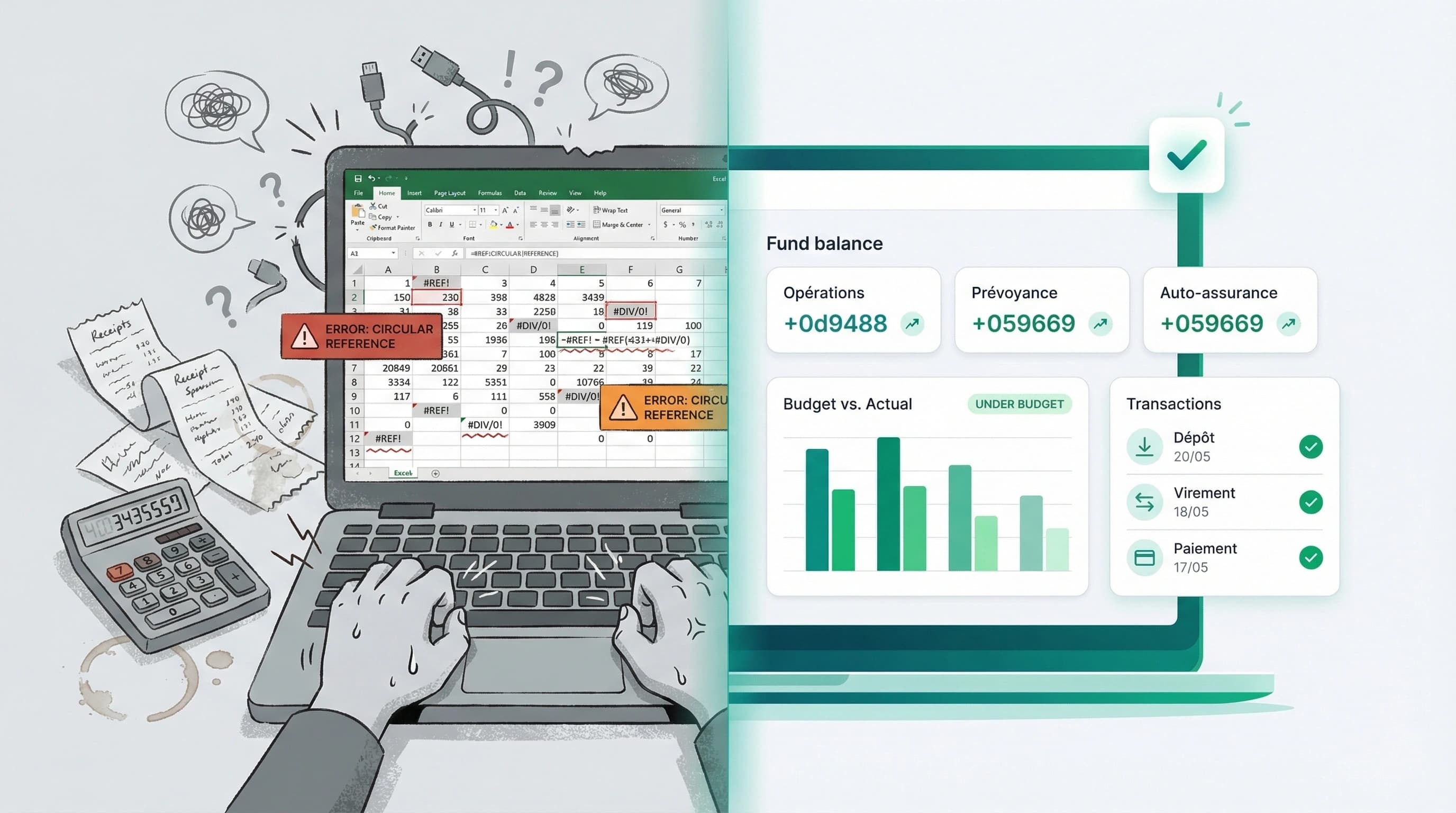
Most self-managed condos handle this with an Excel file that nobody else understands. When the treasurer leaves the board, the next person inherits a mysterious spreadsheet with broken formulas.
CondoAide replaces that spreadsheet with something everyone can use — no training, no accounting jargon.
No debits, no credits — just money in and money out
The philosophy is simple. A condo board member thinks like this:
- Unit 204 paid their March fees.
- We paid the snow removal company.
- We transferred $2,000 to the reserve fund.
- Are we on budget? Who hasn't paid?
That's exactly what CondoAide shows you. No general ledger, no trial balance, no journal entries. You record money coming in or money going out. The system handles the rest.
Behind the scenes, every entry is tied to a fund (operations, reserve, self-insurance), so your accountant gets clean data at year-end. But you never see the complexity.
Should each deposit be split by fund, or is the total enough?
Short answer: split it. Every sum a Quebec condo syndicate receives should be allocated by fund in its books, even when it arrives as a single deposit, because the co-owners' contribution includes sums destined for separate funds (articles 1071, 1071.1 and 1072 CCQ). The monthly contribution divides between the operating fund, the reserve fund (fonds de prévoyance) and the self-insurance fund (fonds d'auto-assurance) according to the budget, and a special contribution goes to the fund it was raised for. The deposit can stay a single line on the bank statement; it is the syndicate's books that must split it.
The question comes up often among volunteer treasurers: when one deposit holds both monthly contributions and a special contribution, do you split each entry, or just record the total?
Why a monthly contribution is not a single sum
Each year, the board of directors sets, after consulting the assembly, the co-owners' contribution to the common expenses, and that contribution includes both the sums needed to meet the expenses of the co-ownership and the sums to be paid into the reserve fund and the self-insurance fund (article 1072 CCQ). A $400 cheque therefore already holds three parts, in the proportions set by the budget.
Those parts do not go to the same place. The reserve fund is allocated only to major repairs and the replacement of the common portions, and it is the property of the syndicate (article 1071 CCQ). The self-insurance fund pays insurance deductibles and must be liquid and available at short notice (article 1071.1 CCQ). The standardized chart of accounts of the Regroupement des gestionnaires et copropriétaires du Québec (RGCQ) follows the same logic: it has separate revenue accounts for regular contributions, reserve fund contributions, special contributions and the insurance fund contribution.
An example: one $1,150 deposit
On March 3, the treasurer deposits three cheques at once: the March contributions for units 101 and 102, at $400 each, and a $350 special contribution from unit 101 raised for the self-insurance fund. Under the budget, each $400 monthly contribution includes $300 for operations, $80 for the reserve fund and $20 for the self-insurance fund.
| Sum received | Operations | Reserve | Self-insurance | Total |
|---|---|---|---|---|
| March contribution, unit 101 | $300 | $80 | $20 | $400 |
| March contribution, unit 102 | $300 | $80 | $20 | $400 |
| Special contribution, unit 101 | $0 | $0 | $350 | $350 |
| March 3 deposit | $600 | $160 | $390 | $1,150 |
The bank statement shows a single $1,150 line. The books show three things: $600 more in the operating fund, $160 in the reserve fund and $390 in the self-insurance fund. And each sum is attributed to the unit that paid it.
What the total-only shortcut costs you
Recording $1,150 as one entry looks simpler, but several things become impossible.
- The reserve fund balance. Nobody can say what the fund holds, yet the sums to pay into it are set taking into account the amounts available in it (article 1071 CCQ).
- The trail of the special contribution. Nothing shows that the $350 went to the purpose for which the special contribution was decided, after consulting the assembly (article 1072.1 CCQ).
- The financial statements. The RGCQ model financial statements present results by fund. Without the split, your accountant has to rebuild the year from bank statements.
- Late payments. A total does not say who paid. That is the first thing you will be asked, for arrears recovery as for a syndicate certificate.
Every deposit, or once a month?
The Code does not set how often the split must be recorded. The easiest to check is to split each deposit when you record it. At a minimum, do it every month, so each fund's balance stays accurate from one bank statement to the next.
If everything lands in the operating account, the other funds' share remains a sum owed to those funds until it is transferred: the RGCQ chart calls these the « à recevoir interfonds » and « à payer interfonds » accounts, interfund receivable and payable. A regular transfer to each fund's account or investment keeps that debt from building up, and the reserve fund must in any case be partly liquid, available at short notice, with its capital guaranteed (article 1071 CCQ).
In CondoAide, the share of each contribution that belongs to the reserve fund and the self-insurance fund is calculated from the budget. The payment is recorded in the operations fund and attributed to the units it pays for. The other funds' share is then moved with a transfer between funds, usually once a month, and each fund's balance updates immediately. A monthly contribution and a special contribution received in the same deposit are recorded as two entries.
These practices describe common bookkeeping; they do not replace your accountant's advice or the requirements of your declaration of co-ownership.
What you can do on the free plan
Basic financial tools are available to all condo associations, including the free plan. We believe every building deserves clear visibility into its finances, regardless of software budget.
Record income and expenses. Common fees received, vendors paid, inter-fund transfers — a 4-field form, not 12. Choose the fund (operations, reserve, self-insurance), the amount, the date, and the category. Done.
See each fund's balance in real time. The dashboard shows three numbers: operations balance, reserve fund balance, self-insurance balance. Click a balance to see the transactions behind it. Every dollar is traceable.
Track payments by unit. Who paid, who's late, how much each owner owes. The unit page shows the full history and current balance. No more digging through Excel to check if unit 302 paid February.
Categorize expenses. Snow removal, insurance, maintenance, administration — your expenses are sorted by category. The budget approved at the annual meeting is your reference: CondoAide compares actual spending to projections for each line item.
Manage vendors. Create a vendor directory with contact details. When you record a payment, select the vendor — the history builds automatically. You know exactly how much you've paid each vendor this year.
Generate financial statements in PDF. At year-end, generate an income statement and balance sheet adapted for condo associations. The document is ready for your annual meeting and for your accountant, if you have one.
And if you want to go further
For associations that want more automation, the Advanced Finances add-on ($29/month) unlocks:
- CSV bank statement import
- Assisted bank reconciliation (automatic matching between your transactions and bank statements)
- Budget vs. actual comparison with overspending alerts
- Year-end assistant with guided checklist
But these tools are a bonus, not a requirement. Everything a small condo needs to keep proper books is already in the free plan.
Built for volunteers, not accountants
Every design decision in CondoAide answers the same question: will a volunteer board member who has never opened QuickBooks understand what they're looking at?
The vocabulary is everyday language. We say "Income" instead of "Credit." "Expense" instead of "Debit." "Balance" instead of "Net Assets." Each screen answers one question at a time: the dashboard answers "Are we OK?", the transaction list answers "Where did the money go?", the unit page answers "Is this owner up to date?"
If you can read a bank statement, you can use CondoAide.
Why not just use Excel?
Excel works — until it doesn't. Here's what we see regularly in self-managed condos:
The treasurer's Excel file is on their personal computer. Other board members can't access it. When an owner asks for a statement, you have to call the treasurer. When the treasurer leaves the board, the file sometimes disappears with them.
Formulas break. One bad copy-paste and the reserve fund balance is off by $4,000 without anyone noticing for six months.
There's no audit trail. Who recorded that transaction? When was it modified? Impossible to tell in an Excel file shared by email.
CondoAide solves all three problems: the data is online (accessible to the entire board), calculations are automatic (no formulas to maintain), and every change is tracked (who, when, what).
The right tool for small condos
Large 200-unit towers have a manager and an accountant. They don't need CondoAide for finances. But associations with 5 to 50 units — the ones that manage everything themselves with volunteers — often have no suitable tool. Too small for QuickBooks, too serious for an improvised spreadsheet.
That's exactly who we built this for. Simple, free for essential features, and rigorous enough that the year-end accountant doesn't have to reconstruct your data.
— The CondoAide Team
Still managing your condo's finances in Excel? Try CondoAide for free →