Quick answer: in Quebec, no law requires a condo syndicate to have its own email address. But a director must hand over to the syndicate everything received in performing their duties (articles 321 and 2184 CCQ), and Quebec's private-sector privacy Act, strengthened by Law 25, requires reasonable security measures for co-owners' personal information. An address in the syndicate's name settles both in advance.
In most small co-ownerships, the board's email is the president's Gmail. Notices go out from it, co-owners reply to it, the insurer and the roofer write to it. It works, until the day the president resigns, moves or falls ill. The new board then inherits a register, sometimes a bank account, but rarely three years of correspondence with suppliers.
This article explains what the law provides, what it does not, and simple ways to give the syndicate an address that belongs to it.
What the law says, and what it does not
No provision requires a syndicate email address. Neither the Civil Code nor Bill 16 mentions one. Be wary of anyone who says it has been "mandatory since Bill 16".
Email is not part of the register. Article 1070 CCQ lists what the register must contain: co-owners' names and postal addresses, minutes, written resolutions, the by-laws, financial statements, the declaration of co-ownership, copies of contracts, the maintenance logbook, the contingency fund study, and all other documents and information relating to the building and the syndicate. The board's mailbox is not named. What matters is the documents inside it: a contract received as an attachment must be filed in the register, whether it came by email or by post.
What a director receives, they receive for the syndicate. A director is considered the mandatary of the legal person (article 321 CCQ). At the end of the mandate, the mandatary must hand over to the mandator everything received in the performance of their duties (article 2184 CCQ). During their term, they may neither mingle the legal person's property with their own nor use, for their own benefit or a third party's, information obtained by reason of their duties (article 323 CCQ).
This is where a personal mailbox becomes a problem. Correspondence exchanged for the syndicate can be part of what the director must hand over. The account itself, opened in the person's name, remains theirs: no provision says it belongs to the syndicate. When a director leaves, the board therefore has to sort out, inside a private mailbox, what belongs to the syndicate and what stays private. We cover that case in Outgoing condo manager: recovering the syndicate's records.
What gets lost with a personal mailbox
- History. The next board finds neither the quotes, nor the exchanges with the insurer after a claim, nor the trace of a co-owner's complaint.
- Access. One person holds the password and the cell number used to recover the account. If they stop answering, nobody else gets in.
- Continuity. Co-owners and suppliers have the president's address saved. When the president changes, messages keep arriving with someone who is no longer on the board.
- Separation. The syndicate's correspondence is mixed with the director's family and work email, which complicates both the handover and the protection of personal information.
What Law 25 changes
The syndicate is an enterprise under the Act respecting the protection of personal information in the private sector, even though it is non-profit. Law 25, adopted in 2021, strengthened that Act, and its new obligations came into force in stages from 2022 to 2024. We explain why in Law 25 for condo syndicates. And the board's correspondence is full of personal information: names, addresses, unit numbers, arrears, water damage, disputes between neighbours.
Four obligations bear directly on the mailbox where those messages land.
- Reasonable security measures. The syndicate must take security measures that are reasonable given the information's sensitivity, purpose, quantity, distribution and medium (section 10). Information spread across five directors' personal mailboxes is hard to protect.
- A person in charge. Within the syndicate, the person exercising the highest authority ensures compliance and acts as the person in charge of protecting personal information, a function they may delegate in writing (section 3.1). They cannot oversee correspondence they never see.
- Incidents, including loss. The Act defines a confidentiality incident as unauthorized access to, use or communication of personal information, and also as the loss of personal information (section 3.6). If a personal mailbox holds information the director keeps for the syndicate, a hack or deletion can be a confidentiality incident: the syndicate must then record it in its incident register and, where there is a risk of serious injury, notify the Commission d'accès à l'information and the people concerned (sections 3.5 and 3.8).
- Destruction. Once the purposes are achieved, the information must be destroyed or anonymized, subject to a retention period provided by law (section 23). The syndicate cannot apply any retention rule to email it does not control.
Location is a further question. Before communicating personal information outside Quebec, an enterprise must conduct a privacy impact assessment (section 17). The Act does not prohibit a service hosted elsewhere, but it requires that assessment first, and consumer email services often process data outside Quebec.
The options, from simplest to most complete
All of them fix the main problem: the address belongs to the syndicate, not to a person.
A shared generic address. The syndicate opens a free account in its own name, for example board.lesjardins@…, and the board shares access. It is better than nothing, but the password circulates, nobody knows who read or deleted what, and account recovery often still depends on one person's phone.
A domain and an office suite. The syndicate buys a domain name and a business email plan, with a shared mailbox or one account per director. It is solid, provided the domain and the main account that manages the suite are in the syndicate's name, someone handles the setup, and the board does the section 17 assessment if the data is hosted outside Quebec.
An address built into the management software. Email arrives in the same place as the register, the units and the suppliers, and access follows the board's roles. That is what we built into CondoAide.
Whichever option you choose, three habits:
- Open the account in the syndicate's name, with a recovery address that survives any director's departure.
- Give the address everywhere: meeting notices, website, contracts, insurer, suppliers. A syndicate address nobody knows is useless.
- Plan the handover: when the board changes, remove the outgoing directors' access and grant it to the new ones, without touching the address.
What the CondoAide address does
On paid plans, the board picks the name of its address under condoaide.ca, for example lesjardins. The syndicate then receives mail at board@lesjardins.condoaide.ca, and the variants conseil@, syndicat@, administration@, info@ and contact@ all land in the same mailbox.
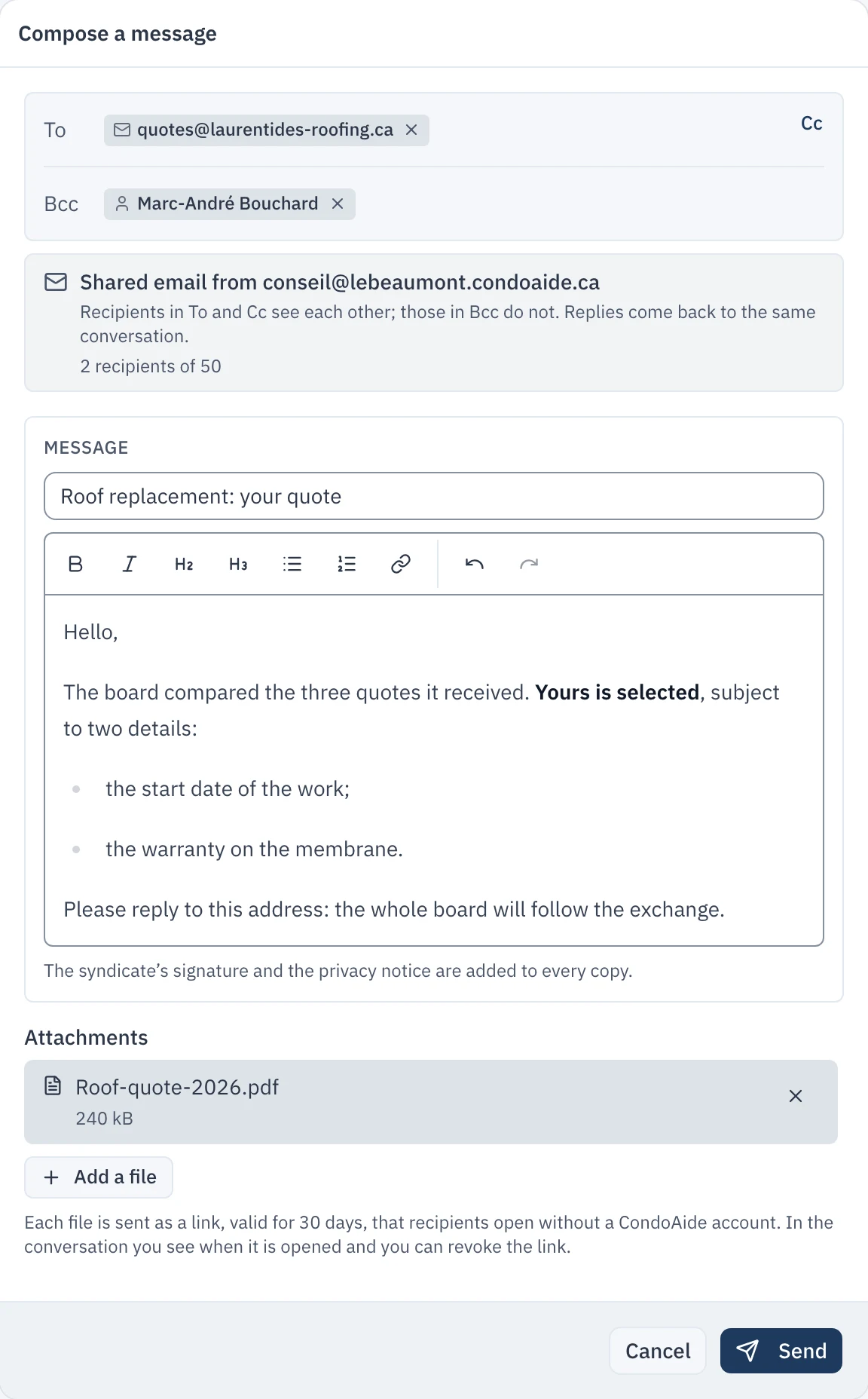
- It stays with the syndicate. When the board changes, the address and its history stay. New directors get access as soon as their role is assigned.
- The board reads it, and reads are logged. Only directors and, if there is one, the syndicate's property manager have access. Every time a person opens a message, it is logged.
- It is connected to the rest of the file. An email from a known co-owner or supplier is attached to their unit or record, and the board can turn it into a request to follow up.
- Notices go out from the same address. A reply to a notice or an announcement comes back to the same mailbox instead of getting lost with one director.
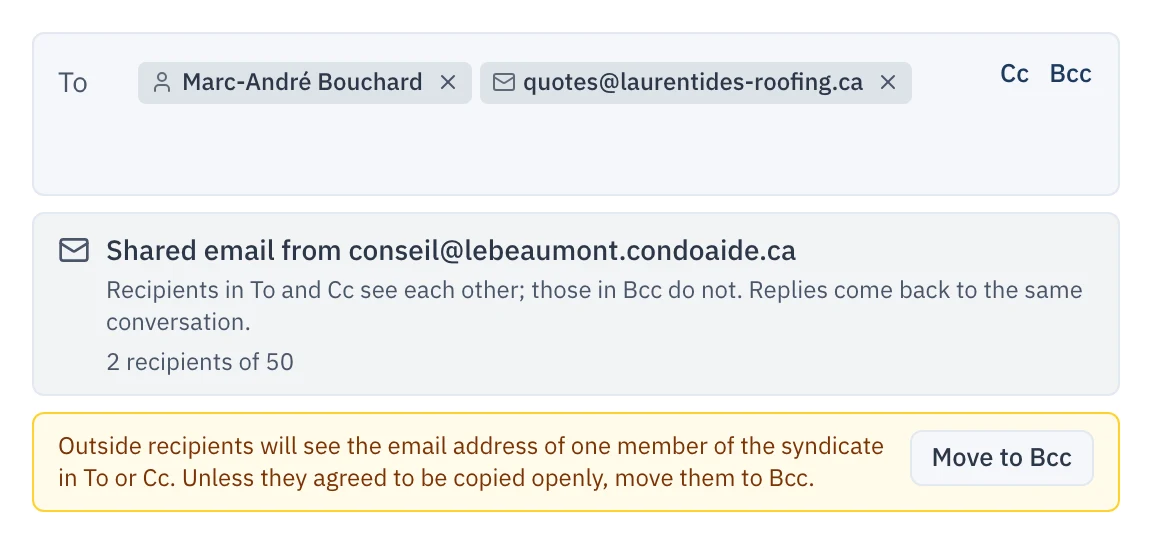
- Co-owners' addresses are protected. If an email to a supplier puts a co-owner in "To" or "Cc", the editor flags it and offers to move them to blind copy.
- Files go out as links. Each attachment becomes a link valid for 30 days, which the board can revoke, and the board sees when it was opened.
- Retention is defined. Received email is kept for 36 months, unless it is filed to a record such as a work order, a contract or a dispute, or placed under a legal hold. Email sent from the mailbox follows the same period.
- The mailbox is hosted in Quebec, in the Montreal region: receiving, sending from the mailbox and storing messages all happen there.
What the tool does not do for you: designate the person in charge of protecting personal information, adopt the governance policy, and decide what goes into the register. Those decisions belong to the board.
Frequently asked questions
Can a director use their personal email for the syndicate?
No law prohibits it. But what they receive for the syndicate, they receive as mandatary and must hand over at the end of their term (articles 321 and 2184 CCQ). And the syndicate remains responsible for the security of the co-owners' information stored there (section 10 of the private-sector privacy Act). An address in the syndicate's name avoids having to untangle the two when the director leaves.
What happens to the email when the board changes?
If the address belongs to the syndicate, nothing: remove the outgoing directors' access and grant it to the new ones. If the email lived in a personal mailbox, the new board has to ask the former director for an export of the syndicate's correspondence and the transfer of the services registered to that address. No provision says the personal account itself belongs to the syndicate.
How long should a syndicate keep its email?
Law 25 sets no fixed period: it requires destroying or anonymizing information once the purposes are achieved, subject to a retention period provided by law (section 23). Documents that travel by email often have their own rule: a contract goes into the register, an invoice follows the tax retention periods. The safest approach is to file those documents where they belong, then set a period for the rest of the correspondence and write it into the syndicate's governance policy.
Does each director need a different address?
No. One address shared by the board is enough for most co-ownerships, provided each person accesses it with their own account rather than a shared password. That is what lets you know who read or sent what, and remove someone's access without changing the address.
Further reading
- Law 25 for condo syndicates: the person in charge, the governance policy, incidents.
- Outgoing condo manager: recovering the syndicate's records: what the departing party must hand over.
- Why a syndicate registry is not a Google Drive folder: what the register must contain.
- Roles, ownership and which email: which email to sign in to CondoAide with, and how to transfer administration.
This article provides general legal information current as of September 26, 2026. It is not legal advice and does not take your syndicate's declaration of co-ownership into account. For a situation that commits your co-ownership, consult a lawyer or a notary.