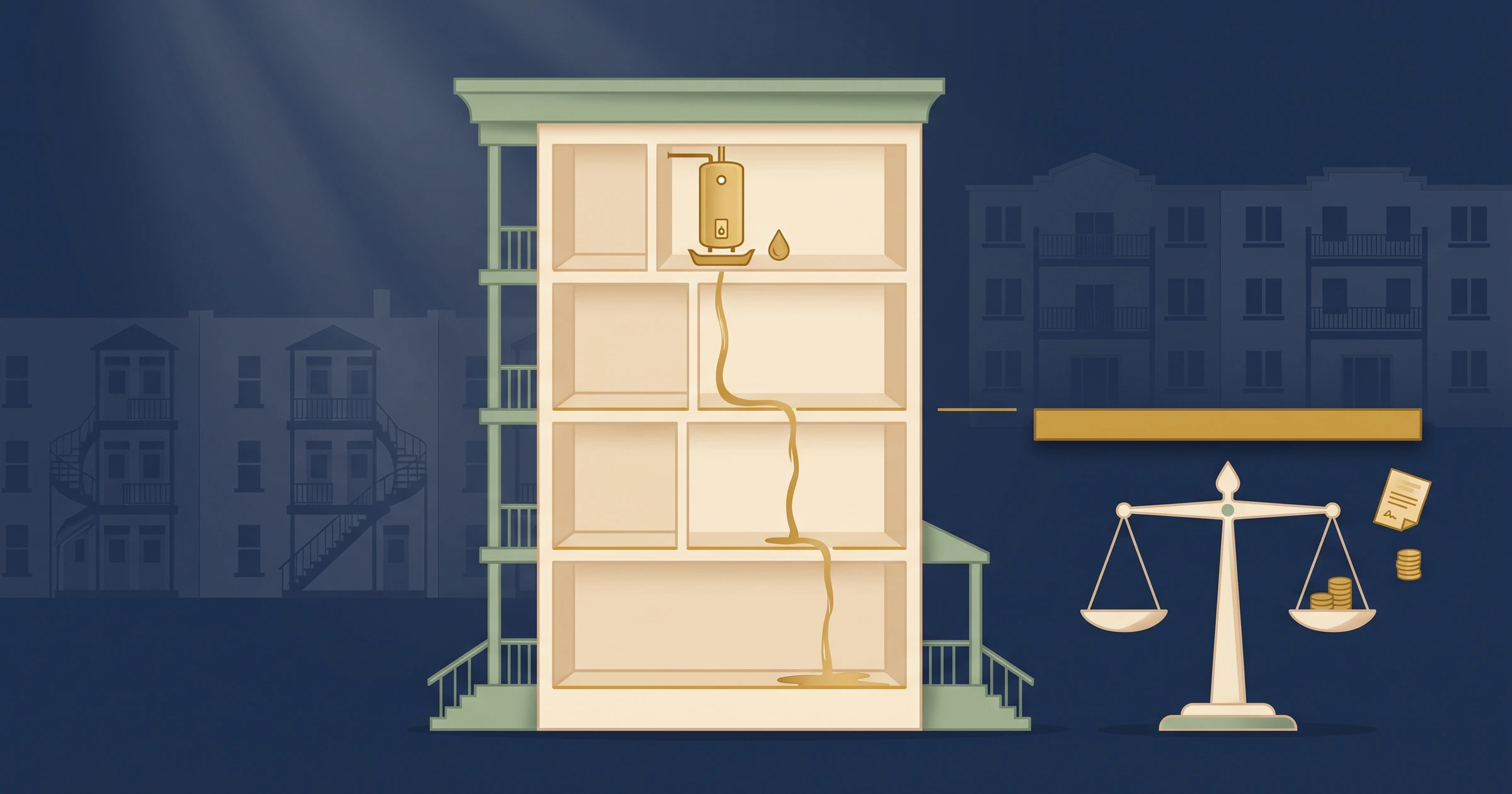
Quick answer: in Quebec, the syndicate's insurance deductible is not billed to the co-owner where the loss started. Article 1074.2 CCQ provides that it may be recovered only through the co-owners' contribution for common expenses, so from everyone. One exception: the syndicate may claim damages from a co-owner at fault or having custody of the thing involved.
That is the distinction almost everyone misses. The syndicate does not send you a "share of the deductible" invoice. To make you pay, it has to sue you in liability and prove something. The difference is not academic: it decides who carries the bill.
Why the deductible starts as a collective charge
The syndicate must insure the entire building, private portions included, with a deductible the law requires to be reasonable:
- The syndicate has an insurable interest in the whole immovable, including the private portions. It shall take out insurance against ordinary risks providing for a reasonable deductible and covering the whole of the immovable, except improvements made by a co-owner to his portion [...]
The centralization is deliberate. As the Court of Québec explains, the legislature wanted to avoid a single loss being split among several insurers: one insurer, the syndicate's, covers the entire risk.
The trade-off is that the syndicate pays the deductible, out of a fund created for exactly that:
1071.1. The syndicate establishes a self-insurance fund which is liquid and available on short notice. The syndicate is the owner of the fund.
The self-insurance fund is to be used to pay the deductibles provided for by the insurance taken out by the syndicate. [...]
That fund is financed by everyone's contributions, alongside the contingency fund (art. 1072 CCQ). In other words, you already pay your share of the deductible every month, inside your common expenses.
The only three cases where one co-owner pays alone
Article 1074.2 CCQ is the operative text:
1074.2. The sums incurred by the syndicate to pay the deductibles and make reparation for the injury caused to property in which the syndicate has an insurable interest may not be recovered from the co-owners otherwise than by their contribution for common expenses, subject to damages it can obtain from the co-owner bound to make reparation for the injury caused by the co-owner's fault and, in the cases provided for in this Code, for the injury caused by the act, omission or fault of another person or by the act of things in the co-owner's custody.
Any stipulation which is inconsistent with the provisions of the first paragraph is deemed unwritten.
Individual liability is therefore limited to three situations:
- the injury is caused by the co-owner's fault;
- in the cases provided for in the Code, by the act, omission or fault of another person;
- in the cases provided for in the Code, by the act of things in the co-owner's custody.
The third one changed everything. It was added in 2020, and it opens the door to article 1465 CCQ:
- The custodian of a thing is bound to make reparation for injury resulting from the autonomous act of the thing, unless he proves that he is not at fault.
That is a presumption of fault. Previously the syndicate had to prove your fault, which was nearly impossible: it has no idea how you maintain your equipment. Now, once the damage is shown to result from the autonomous act of your property, it is on you to show you did nothing wrong. In a co-ownership context the Court of Québec set the standard: the co-owner must show "sustained vigilance" in verifying that such property is in good condition.
The trap Club Marin II exposes
In Syndicat des copropriétaires du Condominium Club Marin II c. Andrade, 2026 QCCQ 3004 (7 July 2026, Huppé J.C.Q.), a water heater on the 16th floor flooded nine private portions and common portions.
The decisive detail is not the water heater. It is the syndicate's deductible: $250,000. A footnote to the judgment records that the unusually high deductible was explained by the number of losses the building suffered in 2019 and 2020.
The damage came to roughly $56,000. Below the deductible. The syndicate therefore could make no claim at all on its insurer: it paid for the repairs itself, then sued the co-owners. The court ordered them to pay $76,231.11, being $48,556.13 in work and $27,674.98 in legal fees claimed under a clause of the declaration of co-ownership.
The lesson for a board: the higher the deductible, the more losses fall into the zone where nobody is indemnified, and where the bill gets settled between the syndicate and a co-owner in court. A high deductible lowers the premium, but it moves the risk.
The mistake that destroys the syndicate's recourse
This is the least known point, and the most expensive. It covers the opposite case: damage that exceeds the deductible.
Article 1074.1 CCQ provides that a syndicate which decides not to avail itself of its insurance may not sue a co-owner, a member of a co-owner's household, or a person whose liability it is required to insure, for the damages for which it would otherwise have been indemnified.
At paragraph 21 the Court of Québec puts it plainly: a syndicate that does not claim is deprived by article 1074.1 CCQ of any recourse against a co-owner, and must absorb the repairs, spread across everyone in proportion to their share.
In practice: a board that decides not to claim in order to protect its loss history or avoid a premium increase simultaneously gives up any possibility of recovering that money from the co-owner responsible. The decision whether to claim is not purely financial; it determines whether a recourse still exists.
Your declaration cannot create automatic liability
The second paragraph of article 1074.2 CCQ makes the rule imperative. A declaration of co-ownership cannot provide that the owner of the appliance behind a loss is always liable. The court uses that exact illustration: co-owners could not decide that whoever owns the water heater is liable whatever the circumstances of the loss.
But do not over-read it. The same decision confirms the declaration remains fully useful to define obligations: a syndicate may adopt rules aimed at preventing losses, such as mandatory replacement of the water heater at a set frequency. The declaration does not set the liability standard; it sets what is expected of the co-owner, and fault is then assessed against those obligations.
Clauses on extrajudicial fees also remain valid, so long as the amount claimed is reasonable. In Club Marin II the argument that the clause was abusive under article 1437 CCQ was rejected, and the $27,674.98 in legal fees was awarded in full.
What to do about it
- Co-owner: your liability insurance is mandatory (art. 1064.1 CCQ), with a minimum amount set by regulation. It is that policy, not the syndicate, that protects you when the article 1465 CCQ presumption runs against you. Check that it actually covers this risk.
- Co-owner: keep proof of your inspections and maintenance. It is the only way to rebut the presumption of fault. A filed inspection invoice beats a recollection.
- Board: know your exact deductible and what it implies. A $250,000 deductible means virtually every ordinary loss will be settled without an insurer.
- Board: record the decision whether to claim in the minutes, with article 1074.1 CCQ in mind. It is a decision that can extinguish a recourse.
- Board: fund the self-insurance fund against the real deductible, as article 1071.1 CCQ requires. A fund calibrated on an old deductible no longer protects anything.
Water damage is the leading home insurance claim in Quebec: according to the Insurance Bureau of Canada, the average claim reached $23,550 in 2024, up 152% over three years.
CondoAide's Compliance module helps the syndicate collect proof of insurance and maintenance per unit and keep it in the registry - according to the rules your syndicate sets in its declaration or by-laws.
What the law does NOT say
- False: "the co-owner at fault must reimburse the deductible." The syndicate does not recover a deductible; it obtains damages, and only if it establishes fault or custody of the thing (art. 1074.2 CCQ).
- False: "the syndicate always pays the deductible." Incomplete. That is the default rule, but article 1074.2 CCQ expressly preserves the claim in damages.
- False: "my declaration says the water heater's owner pays, so that settles it." Such a clause is deemed unwritten.
- False: "if the syndicate does not claim on its insurance, it can still sue me." Not where the damage exceeded the deductible: article 1074.1 CCQ then strips it of any recourse.
- False: "the deductible is capped by law." Article 1073 CCQ requires a "reasonable" deductible, with no figure. In Club Marin II, $250,000 was not challenged.
Frequently asked questions
Can the syndicate bill me its deductible directly? No. Article 1074.2 CCQ provides that those sums may not be recovered from co-owners otherwise than through their contribution for common expenses. To make you pay alone, the syndicate must obtain damages by establishing your fault or your custody of the thing involved.
What happens if the damage is less than the deductible? The syndicate can claim nothing from the insurer and must pay for the repairs itself. It may then sue the co-owner responsible. That is exactly the Club Marin II situation, where a $250,000 deductible made every ordinary loss effectively uninsured.
My appliance was less than 10 years old, am I protected? No. Meeting the replacement deadline in the declaration does not displace the duty to monitor the appliance's condition. See our article on the water heater 10-year rule.
Must the syndicate maintain a fund for its deductibles? Yes. Article 1071.1 CCQ requires a self-insurance fund, liquid and available on short notice, used to pay the deductibles and established on the basis of those deductibles plus a reasonable additional amount.
Further reading
- Civil Code of Québec, art. 1074.2 - recovery of deductibles
- Civil Code of Québec, art. 1074.1 - loss of recourse where the syndicate does not claim
- Civil Code of Québec, art. 1071.1 - self-insurance fund
- Civil Code of Québec, art. 1465 - presumption of fault of the custodian
- Syndicat des copropriétaires du Condominium Club Marin II c. Andrade, 2026 QCCQ 3004 (Court of Québec, 7 July 2026, Huppé J.C.Q.)
- Water heater at 10 years: really mandatory?
- Co-owner compliance in Quebec: five obligations
- The syndicate certificate: complete guide
This article provides general information and is not legal advice. For your particular situation, consult a qualified professional. CondoAide is a management platform - we do not carry out contingency fund studies or accounting audits. For those services, retain a member of a recognized professional order (OIQ, OAQ, OEAQ, OTPQ, CPA).