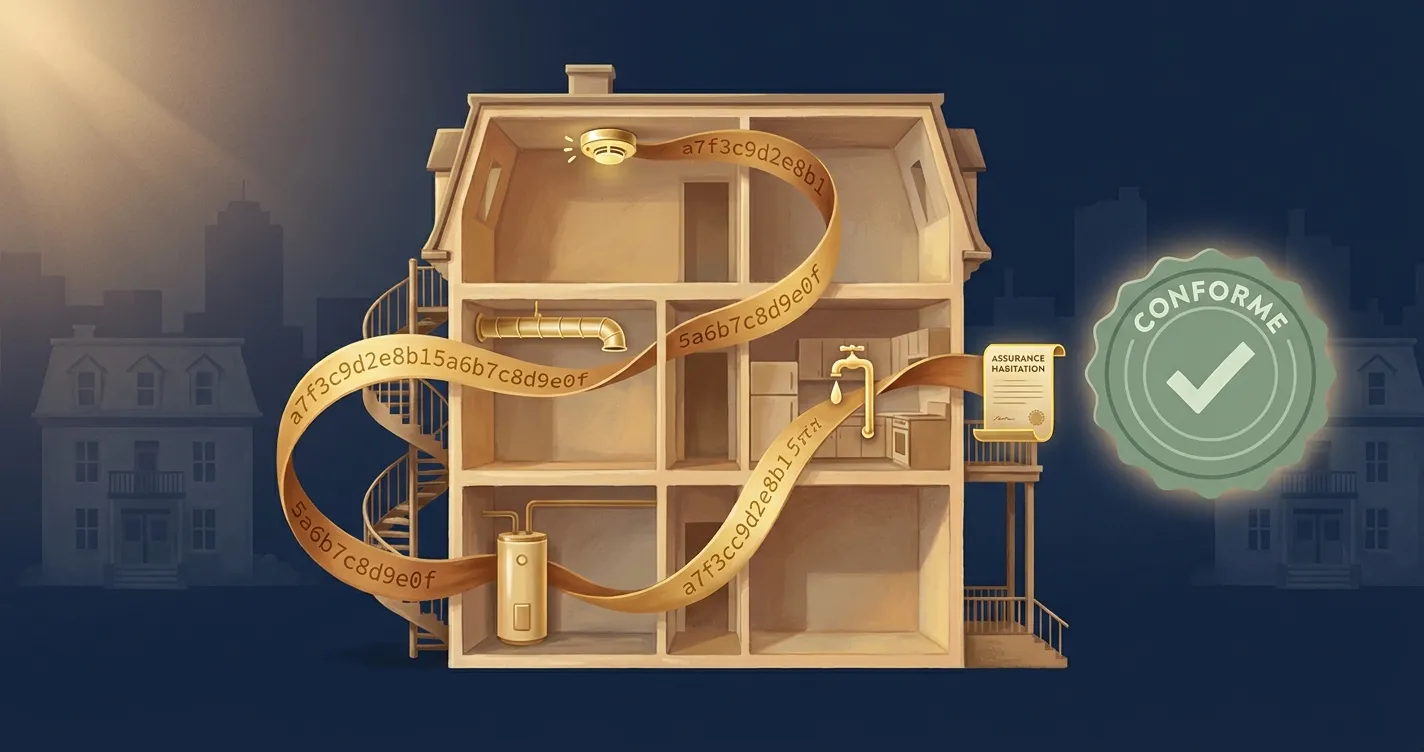
Quick answer: a Quebec condo syndicate must track five recurring obligations for each co-owner — proof of home insurance, duct cleaning, in-unit plumbing, smoke alarm, and water heater (10-year life). CondoAide automates collection, reminders, and history for all five.
Which five obligations must be tracked per co-owner?
A Quebec condo syndicate is not only responsible for the common portions. It must also make sure each co-owner meets a set of obligations that, if neglected, expose the whole syndicate to costly claims and shared civil liability. Five of these recur annually or on a predictable cycle:
- Proof of home insurance — every co-owner must hold a personal insurance policy and provide proof yearly.
- Duct cleaning — dryer vent, range hood, heat-recovery ventilator, and central air conditioner. Typical cycle: every 2 to 3 years.
- In-unit plumbing — flexible hoses (washer, dishwasher, toilet supply line) less than 5 years old, drains flowing normally. Annual check.
- Smoke alarm — two distinct cycles: an annual device test, and replacement of the unit every 10 years per the manufacturer's date.
- Water heater — proof of installation and life tracking. Most insurance policies exclude water damage caused by a water heater older than 10 years. See our dedicated guide: is replacing a water heater every 10 years actually mandatory in Quebec?
Each obligation follows the same pattern: the co-owner provides an attestation or document, the syndicate keeps the record, and the system reminds parties of upcoming deadlines automatically.
What is the legal basis of each obligation in Quebec?
These obligations don't all come from the same place in Quebec law. Some are strictly statutory; others come from the declaration of co-ownership or from insurance-market practice. Here is the basis for each:
Smoke alarm — the clearest. The Quebec Safety Code (RBQ, chapter VIII) requires an annual inspection of the fire alarm system in covered residential buildings. The National Fire Code (NFC) and several municipal by-laws (Montreal, Quebec City, Laval) require a smoke alarm in every dwelling; a monthly battery test is widely recommended (and sometimes required by certain municipal by-laws), and unit replacement is generally expected every 10 years per the manufacturer's date.
Duct cleaning. Since August 14, 2025, Order in Council 991-2025 prescribes the form and content of the syndicate's maintenance logbook (art. 1070.2 CCQ). The syndicate's obligation to have obtained its logbook is staged through August 15, 2028 at the latest (Bill 16, s. 151 — transitional provision: three years and one day after the regulation came into force). The logbook covers ventilation and equipment in the common portions — and in private portions that fall under syndicate responsibility. Most declarations of co-ownership classify dryer vents and air ducts as common portions maintained by the syndicate, while requiring the co-owner to use compliant appliances.
In-unit plumbing. Article 1063 of the Civil Code provides that each co-owner has the disposition of his fraction and the use of his private portion subject to compliance with the building's by-laws and provided he does not impair the rights of other co-owners or the destination of the immovable. The concrete maintenance of private sanitary installations generally flows from the declaration of co-ownership, and civil liability for fault (article 1457 CCQ) applies when damage is caused to other units. The insurance industry treats flexible hoses on washers and dishwashers as a leading cause of claims — hence the widely applied 5-year rule.
Water heater. There is no Quebec law imposing a 10-year maximum life. That rule comes from insurance policies: according to Radio-Canada / La Facture and CAA-Québec, several insurers (Desjardins, Intact, Beneva, La Capitale, Promutuel, Wawanesa) apply a rider excluding water damage caused by a water heater older than 10 to 12 years, or impose a high deductible. When the co-owner has no insurance or coverage excludes the loss, exposure falls back on the syndicate's master policy (art. 1073 CCQ), the self-insurance fund (art. 1071.1), and the special assessment mechanism decided by the general meeting (art. 1072 para. 2). Article 1064.1 CCQ, added by Bill 16, also requires each co-owner to carry civil liability insurance.
Home insurance. The Civil Code does not require a co-owner to insure private property by value, but article 1064.1 CCQ, added by Bill 16, requires civil liability insurance. Most declarations of co-ownership additionally require coverage of private property — and the syndicate's master policy (art. 1073) does not extend to private property. Without proof of individual insurance, the syndicate is exposed every time a loss affects a unit.
Why is the 10-year water heater the most critical obligation?
Because a single failure costs more than the four other obligations combined over a building's lifetime.
A typical Quebec residential water heater holds 40 to 60 gallons of water. When it fails — usually through corrosion of the inner tank after 10 to 15 years — the contents empty all at once. On the third floor of a triplex, that's 200 to 230 litres coming down through the ceilings of the two units below. According to the Insurance Bureau of Canada, water damage represented 100,509 claims in 2024 in Quebec, for an average cost of $23,550 per claim, up 152% in claims volume and 90% in costs over three years. In a multi-storey condo, the incident hits several private portions and common portions at once, multiplying the bill against the residential average.
The syndicate's exposure is twofold:
- If the co-owner has insurance and it pays, the personal policy absorbs the cost (with deductible). The syndicate is in the clear.
- If the co-owner has no insurance, or the policy excludes the loss (typically because the water heater was too old), the syndicate's master policy (art. 1073 CCQ) absorbs the damage to common portions. To fill the gap, the general meeting may decide on a special assessment (art. 1072 para. 2) and the self-insurance fund (art. 1071.1) may be drawn down. The syndicate's recourse against an at-fault co-owner falls under civil liability (art. 1457 CCQ).
And since Syndicat des copropriétaires du Condominium Club Marin II c. Andrade, 2026 QCCQ 3004, meeting the replacement deadline set out in the declaration is no longer enough: co-owners whose water heater had not yet reached ten years were ordered to pay $76,231.11 because they ignored water sitting in the drip pan. The decision and the article 1465 CCQ presumption are covered in our guide Replacing your water heater every 10 years: is it actually mandatory in a Quebec condo?.
The syndicate certificate required by article 1068.1 CCQ must also disclose known issues when a unit is sold, under the categories prescribed by Order in Council 991-2025. An out-of-life water heater is a known issue if the syndicate has been tracking it — which is why keeping a verifiable record matters, rather than discovering the problem on closing day.
That is why CondoAide reminds parties from year 8 of a water heater's life, escalates to the board at year 10, and openly flags non-compliance in the dashboard at year 11.
How does CondoAide automate tracking of all five obligations?
CondoAide offers a Co-owner compliance add-on that covers all five obligations from the existing dashboard and the co-owner portal. Four mechanical pieces:
Per-unit data collection. The co-owner gets an email when an obligation is due. They upload a document (insurance PDF, photo of the water heater nameplate, installer invoice) or check an attestation (for plumbing and smoke alarm). For water heaters, a parser automatically extracts the install date from the invoice or the nameplate.
Automatic reminders ahead of deadlines. Each obligation has its own cycle — insurance follows the policy expiration date, ducts follow a fixed interval, the water heater follows the appliance's age. The system sends a reminder 30 days before the deadline by default (configurable), then weekly until compliance, and escalates to the board after 60 days of non-compliance.
Co-owner portal — "My obligations". The co-owner sees all five statuses on a single screen: green (compliant until X), yellow (action required within X days), red (non-compliant). No confusion about what's due.
Admin dashboard — compliance percentage by obligation. The acting administrator sees at a glance the syndicate's compliance percentage for each of the five obligations. Filters by unit, obligation, and status. CSV-exportable to attach to the condo meeting minutes.
See our comparison with Excel for why a spreadsheet no longer cuts it for this kind of tracking.
What happens when a unit changes hands?
The principle: physical infrastructure stays with the unit; the insurance policy stays with the person.
In practice:
- Insurance: the new buyer needs their own policy. CondoAide automatically creates a new "pending" obligation for the new person. The previous policy stays in history for date-based claim queries.
- Duct cleaning: the last cleaning date and the attached document stay attached to the unit. The dryer didn't move. The cycle continues as-is.
- Plumbing: the last attestation remains valid. CondoAide offers a "fresh check on possession" to the new co-owner — optional, not required.
- Smoke alarm and water heater: appliances are fixed to the unit. The 10-year counter keeps running from the original install date. The new buyer inherits a 7-year-old unit with 3 years left — this is a feature, not a bug: they purchase the unit knowing exactly what must be replaced and when.
This behaviour also reinforces the syndicate's certificate (article 1068.1 CCQ, content prescribed by Order in Council 991-2025) generated for a sale: the buyer gets a faithful picture of the unit's compliance on the five obligations because the data is not reset on each sale.
How does the Compliance add-on fit with the Bill 16 maintenance logbook?
CondoAide structures data per unit and per obligation: insurance proof, duct-cleaning dates, in-unit plumbing, annual smoke-alarm test, and water heater (with a 10-year reference life). For each obligation, the administrator can grant exemptions unit by unit (e.g., a loft with no electric water heater) with a reason and an effective date — an exempted unit no longer appears as non-compliant on the dashboard nor on the syndicate's certificate.
The maintenance logbook itself is managed separately in the Logbook & maintenance module: the administrator imports the existing logbook or adds components (roof, boiler, ventilation, etc.) and recurring tasks. The Compliance add-on does not push anything automatically into the logbook — it is an editorial choice of the syndicate to decide which private-portion data (if any) feeds the professional deliverable.
For the full logbook practice, see our practical maintenance logbook guide.
Important note (reserved act). The final maintenance logbook required by article 1070.2 CCQ and Order in Council 991-2025 must be issued by a qualified person — a member of a recognized professional order within the meaning of Order 991-2025 (s. 1). CondoAide structures and retains the data feeding that professional deliverable; CondoAide does not produce the maintenance logbook itself and does not substitute for the responsible professional.
How much does the Co-owner compliance add-on cost?
$9/month — unchanged. Same price as the former "Insurance proof" add-on. Higher-tier plans (Management, Pro, Gestionnaire, Founder) include the add-on at no extra cost.
| Plan | Co-owner compliance |
|---|---|
| Free (up to 5 units) | $9/month as add-on |
| Starter (up to 50 units) | $9/month as add-on |
| Management (up to 50 units) | Included |
| Pro (up to 200 units) | Included |
| Gestionnaire (managers) | Included |
The add-on covers all five obligations with no per-obligation surcharge. A syndicate may activate insurance and water heater only — pricing stays the same. See our Pricing page for plan details.
Frequently asked questions about co-owner compliance
Does the Compliance add-on replace the old Insurance add-on? Yes. It is the same product with an extended name and four additional obligations. Existing customers are migrated automatically with no interruption or price change.
Do all five obligations need to be activated? No. Each obligation activates independently in the syndicate settings. A triplex with no HVAC doesn't activate duct cleaning; a building under 8 dwellings can skip the building-track fire alarm.
What happens if a co-owner refuses to provide proof? CondoAide sends reminders on the configured cycle, then escalates to the board after 60 days by default. The dashboard lets the administrator log a response or initiate formal steps.
Does an attestation for plumbing carry legal weight? Yes. The add-on generates a contractual attestation toward the syndicate. A false statement may engage the co-owner's personal civil liability (article 1457 CCQ — liability for fault) as well as their contractual liability toward the syndicate. That is the legal lever the syndicate is looking for.
Does water heater tracking require a physical visit? No. The co-owner uploads a photo of the water heater nameplate or the installation invoice. The parser extracts the date. A visit is not required for registry compliance.
What happens when a water heater is replaced? The administrator or the co-owner creates a new appliance in the system with its new install date. The old one is marked "retired". The 10-year counter restarts from the new installation.
Is the data hosted in Quebec? Yes. Application servers (Vercel — YUL region, Montreal) and the database (Supabase — ca-central-1, Montreal) are in Quebec, and backups are kept there. Some technical subprocessors (subscription billing, transactional email, opt-in AI features) may process some data outside Canada; the full list is in our privacy policy. CondoAide is designed to meet Law 25 obligations — details on the Security & hosting page.
Can data be exported? Yes. The dashboard exports to CSV; uploaded documents download individually; in case of service termination, a complete export is guaranteed.
Where owner compliance sits among the syndicate's own obligations
These five obligations are the ones the syndicate tracks against each co-owner. They are distinct from the obligations the syndicate carries itself:
- Complete guide to Bill 16 — the maintenance logbook, the contingency fund study, and the August 15, 2028 deadline, all of which fall on the syndicate rather than on co-owners.
- Syndicate certificate — the document handed to a seller on a sale, where the tracking of these five obligations ends up being read.
- Condo meeting minutes — where the board records the decisions it takes off the compliance dashboard, within the 30-day deadline of article 1102.1 CCQ.
- The 10-year water heater in a Quebec condo — where the 10-year rule actually comes from, and why meeting it no longer shields the co-owner since Club Marin II (2026).
Activate Co-owner compliance in minutes
Existing customers receive the extension automatically. For new syndicates, the Compliance add-on activates from the dashboard — you choose the obligations applicable to your building and the system handles reminders, collection, and tracking.
Create a free account → · See plans → · Compare with Excel →