Short answer: the syndicate's insurance covers the whole building, including private portions, but excludes the improvements a co-owner made to their portion when those improvements can be identified against the description of that portion (art. 1073 CCQ). For that exclusion to work cleanly, the syndicate's register must contain "a description of the private portions that is sufficiently precise to allow the improvements made by the co-owners to be identified" (art. 1070 CCQ). That description of the original state is the reference unit. Without it, nobody can prove after a loss what was original and what the co-owner added - and it is the co-owner who stands to lose.
What exactly is a reference unit?
The phrase "reference unit" does not appear as such in the Civil Code. It is the name practice gives to a very real requirement: the description of the reference state of a private portion, as delivered at construction.
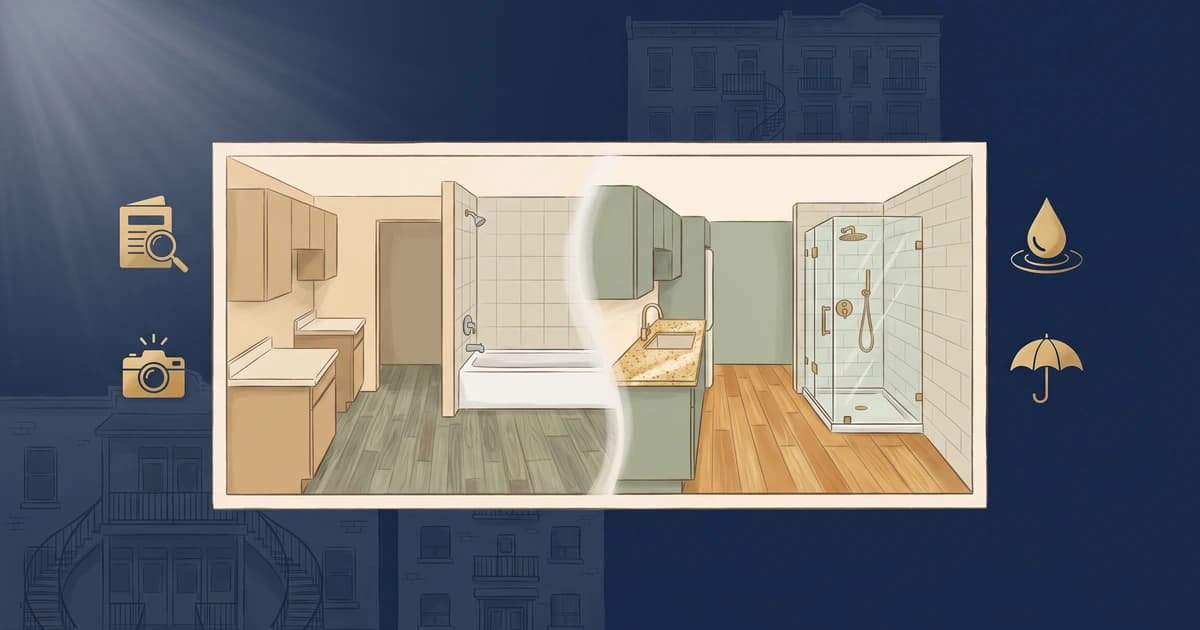
Concretely, it is the sheet that records what a brand-new unit looked like: laminate counters, vinyl flooring, melamine cabinets, a standard bathtub, and so on. Anything a co-owner - current or past - added or upgraded on top of that reference state is an improvement: the quartz counter, the hardwood floor, the glass shower, the heated floor.
The Code even provides that "one description may apply to several portions where they have the same characteristics" (art. 1070 CCQ). In other words, you do not describe 48 units one by one: you describe a type (the one-bedroom, the two-bedroom, the penthouse) and that description applies to every unit of that type. That is exactly the logic of the reference unit per unit type.
What the law says
Two articles fit together, and it is their combination that drives the whole topic.
1. The register must make improvements identifiable (art. 1070 CCQ). The last paragraph of article 1070 CCQ is unambiguous: the register contains "a description of the private portions that is sufficiently precise to allow the improvements made by the co-owners to be identified. One description may apply to several portions where they have the same characteristics." This obligation was introduced by Bill 141 (2018) and Bill 16 (2019); the accompanying insurance regime has been in force since April 15, 2020.
2. The syndicate's insurance excludes identifiable improvements (art. 1073 CCQ). Article 1073 CCQ requires the syndicate to insure "the whole of the immovable, excluding the improvements made by a co-owner to his part where they can be identified in relation to the description of that part." The condition is explicit: the exclusion only bites when the improvement can be tied back to the description. No precise description, no clear identification - and the line between "original" and "improvement" becomes a dispute.
The same article adds that the coverage must fund the building's reconstruction and "must be reassessed at least every five years by a member of a professional order designated by government regulation." That reconstruction-value assessment is a reserved act: it belongs to a certified appraiser, not to software.
Finally, the co-owner's personal insurance is separate from the syndicate's: each co-owner insures their own private portion and their own improvements (art. 1064 CCQ). That is where a co-owner's improvements must be covered - the personal policy - provided they were declared to the insurer.
The scenario that gets expensive
An example makes the mechanics obvious.
A unit delivered in 2018 with standard finishes: laminate counters, vinyl flooring. In 2024, the co-owner renovates: quartz, hardwood, heated floor, glass shower. They declare nothing to anyone, then sell in 2025. In 2026, the new buyer suffers water damage.
Without an improvements registry, nobody can prove what was original. The expert assessment drags on, values are contested, and the syndicate's insurance reimburses, at best, the value of the original laminate counter, not the quartz. The difference falls on the occupant - and if they had not insured it on their personal policy, they pay out of pocket. A common outcome: reduced indemnity, friction between the co-owner, the syndicate, and the insurers, sometimes a lawsuit.
With the registry - board resolution, before/after photos, materials, approximate cost, date, contractor - the syndicate keeps a reliable history that survives the sale. The new buyer benefits indirectly: the proof exists, the line is clean, and the claim settles faster.
In practice for your syndicate
For a 48-unit building split into three types, the process comes down to three steps:
| Step | Who | Content |
|---|---|---|
| Describe the reference state | The syndicate, once | Original finishes, materials, and equipment, per unit type (art. 1070 CCQ) |
| Record each improvement | The syndicate, as work happens | Date, category, description, materials, approximate value, contractor, board resolution |
| Document | The syndicate + the co-owner | Before/after photos, plans, permits, contract, invoice, warranty |
The split of responsibilities is simple. The co-owner informs the syndicate of their work and provides plans, invoices, photos, and warranties; they are also the one who insures their improvements on their personal policy. The syndicate keeps the documents, maintains the registry, keeps the resolutions, and hands the information to the next board - "as long as the building exists."
Mistakes to avoid:
- Waiting for the loss to reconstruct the original state: too late, the proof no longer exists.
- Describing each unit individually when the law allows one description per type (art. 1070 CCQ): wasted effort.
- Assuming the syndicate's insurance covers improvements: it excludes them as soon as they are identifiable (art. 1073 CCQ).
- Forgetting to declare your renovations to your own insurer: an undeclared improvement is covered nowhere.
How CondoAide handles it
CondoAide includes a private-improvements registry attached to each unit:
- You describe the reference unit per unit type - original finishes, materials, and equipment. One description serves every unit of the same type, as art. 1070 CCQ allows.
- You record each improvement on the unit's sheet: date, category, description, materials, approximate value, contractor (with their RBQ licence), a link to the board resolution, and a "touches common portions" flag for work that also concerns the syndicate (moving a duct, adding an EV charger).
- You attach documents and before/after photos, with version history - the supporting file stays linked, never overwritten.
- You generate a PDF of the registry - per unit or for the whole building - to hand to the insurer or the expert at claim time.
- Everything is attached to the unit, not the co-owner: the history survives the sale and benefits the next buyer.
CondoAide is a management tool: it structures and preserves the description and improvements your syndicate records. It does not perform the reconstruction-value assessment (art. 1073 CCQ) and does not opine on whether coverage is sufficient - those acts belong to a certified appraiser and your insurer.
What is NOT in the law
- "The syndicate's insurance covers my renovations" - false. It excludes a co-owner's improvements as soon as they can be identified against the description of their portion (art. 1073 CCQ). You insure them yourself (art. 1064 CCQ).
- "Recording an improvement in the register modifies the declaration of co-ownership" - false. Recording a renovation in the register (art. 1070) is not the same as modifying the description of the private portions in the descriptive statement, which requires a three-quarters vote (art. 1097 CCQ).
- "The reference unit is an obligation named by Bill 16" - imprecise. The Code does not name the "reference unit"; it requires a description of the private portions precise enough to identify improvements (art. 1070), and the insurance regime that makes it unavoidable comes from Bill 141 (2018, in force 2020), not Bill 16 alone.
- "The syndicate must describe each unit separately" - false. One description applies to several portions of the same characteristics (art. 1070 CCQ).
Frequently asked questions
After water damage, who pays for my renovations in a condo? The syndicate's insurance covers the building, but it excludes your improvements when they can be identified against the description of your private portion (art. 1073 CCQ). Those improvements must be covered by your personal co-owner insurance (art. 1064 CCQ), provided you declared them to your insurer.
What is the reference unit? It is the description of a private portion's original state, as delivered at construction. It serves as the comparison point to distinguish what is original from what a co-owner has improved. The Code requires it indirectly, by demanding a description "sufficiently precise to allow the improvements to be identified" (art. 1070 CCQ).
Does the syndicate really have to keep an improvements registry? The syndicate's register must contain a description of the private portions precise enough to make improvements identifiable (art. 1070 CCQ). A structured improvements registry, with before/after photos and documents, is the practical way to meet that requirement and to prepare for a future claim.
Does this information survive the sale of the unit? Yes, if it is attached to the unit and not the co-owner. That is the whole point of a per-unit registry: the improvement history stays attached to the unit and benefits the next buyer.
Further reading
- Civil Code of Québec, art. 1070 - register and description of the private portions
- Civil Code of Québec, art. 1073 - syndicate insurance and the improvements exclusion
- Civil Code of Québec, art. 1064 - insurance of the private portion
- The co-ownership register vs a plain Google Drive
- Condo renovations in Quebec: board approval and RBQ licence - before the work: authorization and the contractor's licence
- The syndicate certificate: complete guide
- Five co-owner obligations in Quebec
This article provides general information and is not legal or insurance advice. For a decision that binds the syndicate, consult your notary, your broker, or your insurer. CondoAide is a management platform - we do not perform reconstruction-value assessments or insurance audits. For those services, retain a member of a recognized professional order (OIQ, OAQ, OEAQ, OTPQ, CPA) or your insurer.