
Quick answer: in Quebec, a co-owner freely uses their private portion (article 1063 CCQ), but it is the declaration of co-ownership that sets out which work needs the syndicate's authorization. Before authorizing, the board can ask who will do the work and for the contractor's licence number, then check that number in the public register of the Régie du bâtiment du Québec (RBQ).
Two situations keep coming up in Quebec co-owner groups. In the first, a co-owner wants to replace the windows of their private portion themselves, without authorization, and then have the syndicate reimburse them. In the second, a co-owner starts concrete work on the staircase that serves as an emergency exit, despite the board's refusal. Both boards ask the same question: what can a co-owner do alone, and what can the syndicate require?
This article follows the order in which things happen: what the Civil Code says, what the board can ask for before authorizing, how to read an RBQ licence, and what the syndicate can still do once the work was done without its authorization.
What a co-owner can do alone
The starting point is freedom. Each co-owner freely uses and enjoys their private portion and the common portions, provided they comply with the by-laws of the immovable and do not impair the rights of the other co-owners or the destination of the immovable (article 1063 CCQ).
So, as a general rule, the Civil Code does not require the board's approval for work in a private portion. In most buildings, what requires it is the declaration of co-ownership. The act constituting the co-ownership, the first part of the declaration, sets out the respective powers of the board of directors and of the general meeting of co-owners (article 1053 CCQ). The by-laws of the immovable contain the rules on the enjoyment, use and upkeep of the private and common portions (article 1054 CCQ). That is where you find, for example, the obligation to get the board's written authorization before changing a floor covering or moving a bathroom.
That power has a limit: the declaration may not impose any restriction on the rights of the co-owners except restrictions justified by the destination, characteristics or location of the immovable (article 1056 CCQ). A soundproofing requirement in a concrete building is easy to justify; a refusal with no reason tied to the building, much less so.
"My place" does not always mean private
The most common trap is believing that everything inside one's own dwelling belongs to the co-owner. The Code presumes common, among other things, the main structure of the buildings (foundations, load-bearing walls, slabs) and the pipes, including those that run through private portions (article 1044 CCQ). Partitions that are not part of the main structure and that separate a private portion from a common portion or from another private portion are presumed to be common walls, shared by both neighbours (article 1045 CCQ).
Redoing a bathroom almost always touches a common pipe. Opening a wall can touch the main structure. And windows, depending on the declaration, are sometimes private and sometimes restricted common portions: the declaration decides, and it also says who pays to replace them. A co-owner who replaces a common element on their own cannot assume the syndicate will reimburse them.
What the board can ask for before authorizing
No statute lists the documents a board may require from a co-owner who wants to do work. That list comes from the declaration of co-ownership and from practice, and each requirement must be justifiable by the building (article 1056 CCQ). In practice, a complete request contains:
- A description of the work: what, where in the private portion, with which materials.
- The planned dates: the start, and the end if known, to warn the neighbours and plan access.
- Who will do the work: the co-owner themselves or a contractor, with the company's name and its RBQ licence number.
- Proof of insurance: every co-owner must hold civil liability insurance towards third persons (article 1064.1 CCQ), and water damage during work is exactly the risk in question.
- Plans, when the work touches a partition, a pipe or the structure.
Once the work is authorized and done, keep a record of it. The syndicate's register must describe the private portions precisely enough that the improvements made by the co-owners can be identified (article 1070 CCQ). That is what tells you, after a loss, what the syndicate's insurance covers: see improvements and the reference unit.
Why the RBQ licence matters to the syndicate too
The Building Act reserves carrying out construction work for others to licence holders. To act as a building contractor, you must hold a licence in force (section 46 of the Building Act). A contractor is a person who, for others, carries out or has carried out construction work (section 7), and renovation, repair and alteration count as construction work (section 9). Acting as a contractor without a licence exposes an individual to a minimum fine of more than $14,000, indexed annually (section 197.1).
A co-owner doing their own work is not acting for others, so they are not a contractor; in some cases the Act even exempts them from the owner-builder licence. Even then, only a contractor may do work on a gas installation or an electrical installation (section 49).
For the syndicate, a licence is not a guarantee of quality. It is a minimal signal, free and public: the company the co-owner chose is allowed to work, and it really is the one on the register.
Reading the RBQ register
The RBQ keeps a public register of licence holders: their name, their address, the licence number and categories and, where applicable, any restriction (section 66). It can be searched free of charge on the RBQ website, using the licence number on the quote or the contract. Four situations can arise.
Licence in force. The company may work in the categories on its licence (section 68): check that they cover the planned work. Check that the registered holder is the company named in the quote: a number borrowed from another company is a red flag.
Licence in force, with a restriction. This is the answer most often misunderstood. The restriction only prevents the holder from bidding on or entering into a public contract (section 65.1), (section 65.2). On its own, it does not bar work in a private portion. It can, however, result from convictions of the holder or one of its officers for certain offences, such as fraud, collusion or a tax offence, generally within the past five years: the board may want to know more before deciding.
Licence no longer in force. A licence can be suspended or cancelled by the RBQ (section 70), or cease to have effect, for example after a bankruptcy or when the fees payable to maintain it have not been paid (section 71). In every one of these cases, the company can no longer act as a contractor until it holds a licence in force again.
Number not found. Often a typo. Ask the contractor for the number again before drawing any conclusion.
Work done without authorization, or despite a refusal
Start by writing. A formal demand letter (mise en demeure) asking the co-owner to stop the work and restore the premises, citing the clause of the declaration at issue, sets out the syndicate's position and will serve as evidence. It is also why a refusal is best given in writing, with its reason: no rule requires it, but that document is what separates a poorly informed co-owner from one who went ahead anyway.
If the co-owner persists, the Civil Code provides for an injunction. When a co-owner's refusal to comply with the declaration causes serious and irreparable prejudice to the syndicate or to another co-owner, whoever suffers that prejudice may ask the court to order the co-owner to comply with the declaration (article 1080 CCQ). The bar is high: work that affects an emergency exit or the structure is more likely to reach it than a new faucet. If the co-owner does not obey the injunction, the court can go as far as ordering the sale of their fraction, meaning their private portion and their share of the common portions.
For damages, the Code has a rule specific to work. If work causes prejudice to a co-owner, such as damage or a serious disturbance of enjoyment, the co-owner who did the work must compensate them, unless the syndicate had requested it (article 1067 CCQ). The syndicate can also claim damages from the co-owner at fault; when the work causes an insured loss, the law expressly preserves that claim for the deductible and the repairs (article 1074.2 CCQ). If the declaration contains a penal clause, meaning a penalty set in advance, it may apply as well (article 1053 CCQ).
A forced restoration goes through the court. As a general rule, the Code allows a person to be authorized to demolish or remove, at the other party's expense, what that party did when it was bound not to (article 1603 CCQ). How it applies to your declaration is a question for a lawyer.
And the "three quotes"?
No article of the Civil Code requires a syndicate to get three quotes, whether for a repair or for major work. If your building has that rule, it comes from its declaration of co-ownership, often the by-laws of the immovable, or from a board policy. What the Code requires is that directors act with prudence and diligence (article 322 CCQ): comparing prices is one way to show it, not a formality imposed by law.
In CondoAide: the contractor is part of the request
In CondoAide, a co-owner files their work authorization request under "New request". They describe the work, the location and the dates, then answer "Who will do the work?". If it is a contractor, the licence field searches the RBQ register as they type, by number or company name.
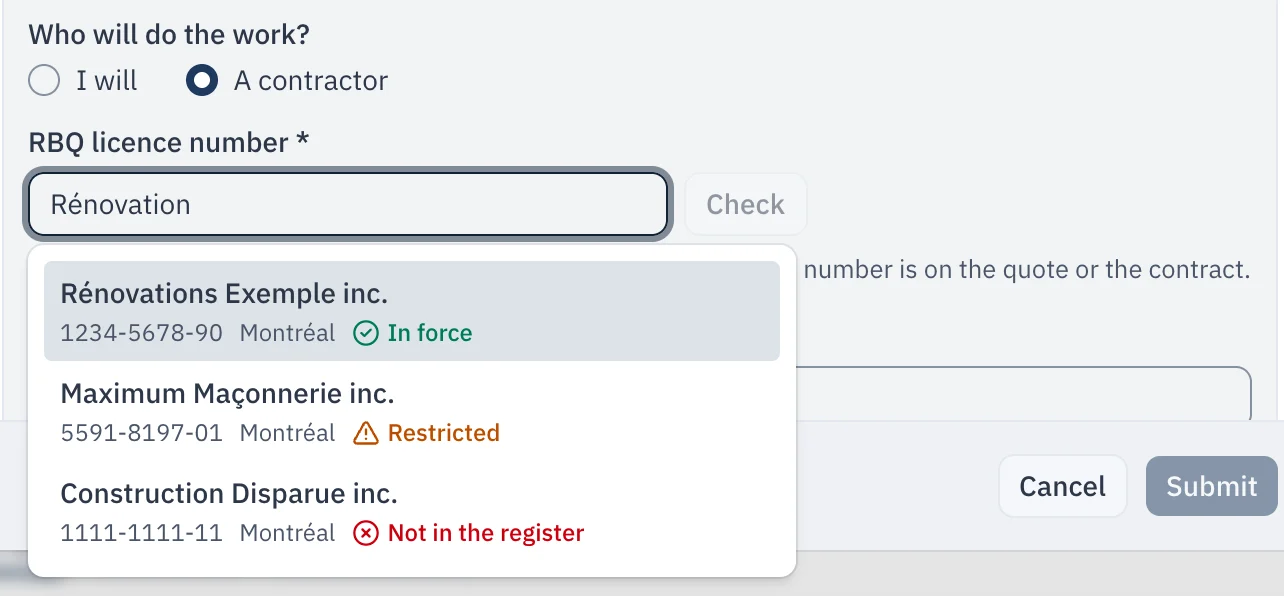
The board sees the register's answer on the request before deciding: a licence in force, restricted or no longer in the register, the registered holder when it differs from the company given, and the date of the check. The licence is checked again when the board puts the request on an agenda.
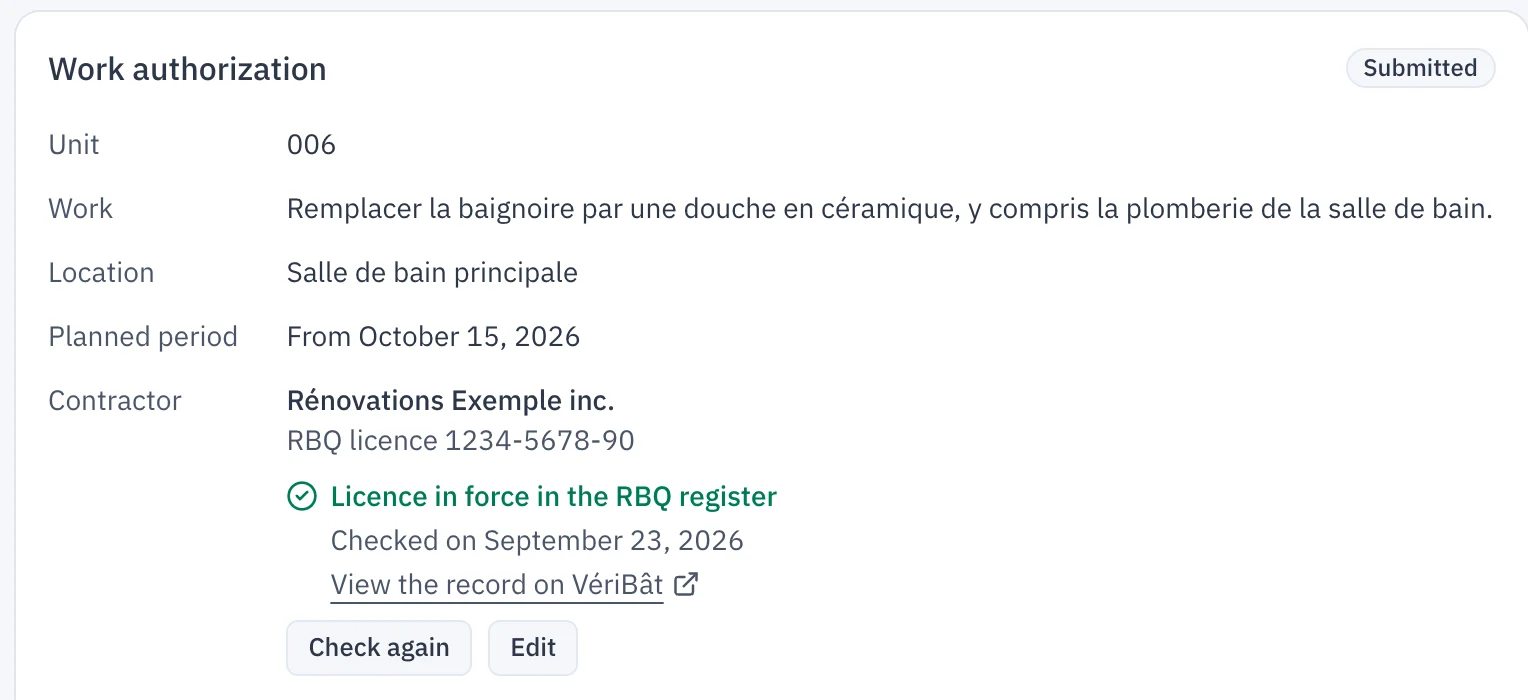
The check goes through VériBât, another service of Solutions Nicvi inc., the company that runs CondoAide. Only the licence number, or the text typed to search, is sent to it. CondoAide reports what the public register says; the decision to authorize the work stays with the board.
Frequently asked questions
Does a co-owner need the syndicate's authorization to renovate their private portion?
Not under the Civil Code alone: a co-owner freely uses their private portion (article 1063 CCQ). Authorization is required when the declaration of co-ownership says so, which is common, and when the work touches a common portion, such as a pipe or the main structure, which are presumed common (article 1044 CCQ); altering a common portion may even require a vote of the general meeting (article 1097 CCQ).
What is an RBQ licence "with a restriction"?
A licence whose holder may neither bid on nor enter into a public contract (sections 65.1 and 65.2 of the Building Act). On its own, the restriction does not bar private work in a condominium, but it can result from a recent conviction.
How do I check a contractor's RBQ licence?
With the number on their quote or contract, in the public register of the Régie du bâtiment du Québec (section 66 of the Building Act). Check that the licence is in force and that the registered holder is the company that will do the work.
What can the syndicate do if work was done without authorization?
Send a formal demand letter asking that the work stop and the premises be restored, citing the declaration. If the refusal to comply causes serious and irreparable prejudice, the syndicate can ask the court for an injunction (article 1080 CCQ), and it can claim damages from the co-owner at fault.
Does the syndicate have to get three quotes before work?
No article of the Civil Code requires it. The obligation can come from the declaration or a board policy; the law mainly asks directors to act with prudence and diligence (article 322 CCQ).
Further reading
- PCUR and relative charges: who pays what in a Quebec condo?: when windows are a restricted common portion.
- Unit improvements and the reference unit: recording authorized work so it survives a loss and a sale.
- Condo insurance deductible in Quebec: who actually pays?: when water damage happens during the work.
- Condo meeting minutes (Quebec): recording the board's decision on a work request.
This article provides general legal information current as of September 23, 2026. It is not legal advice and does not take into account your syndicate's declaration of co-ownership or by-laws of the immovable. For a specific situation, consult a lawyer or a notary.