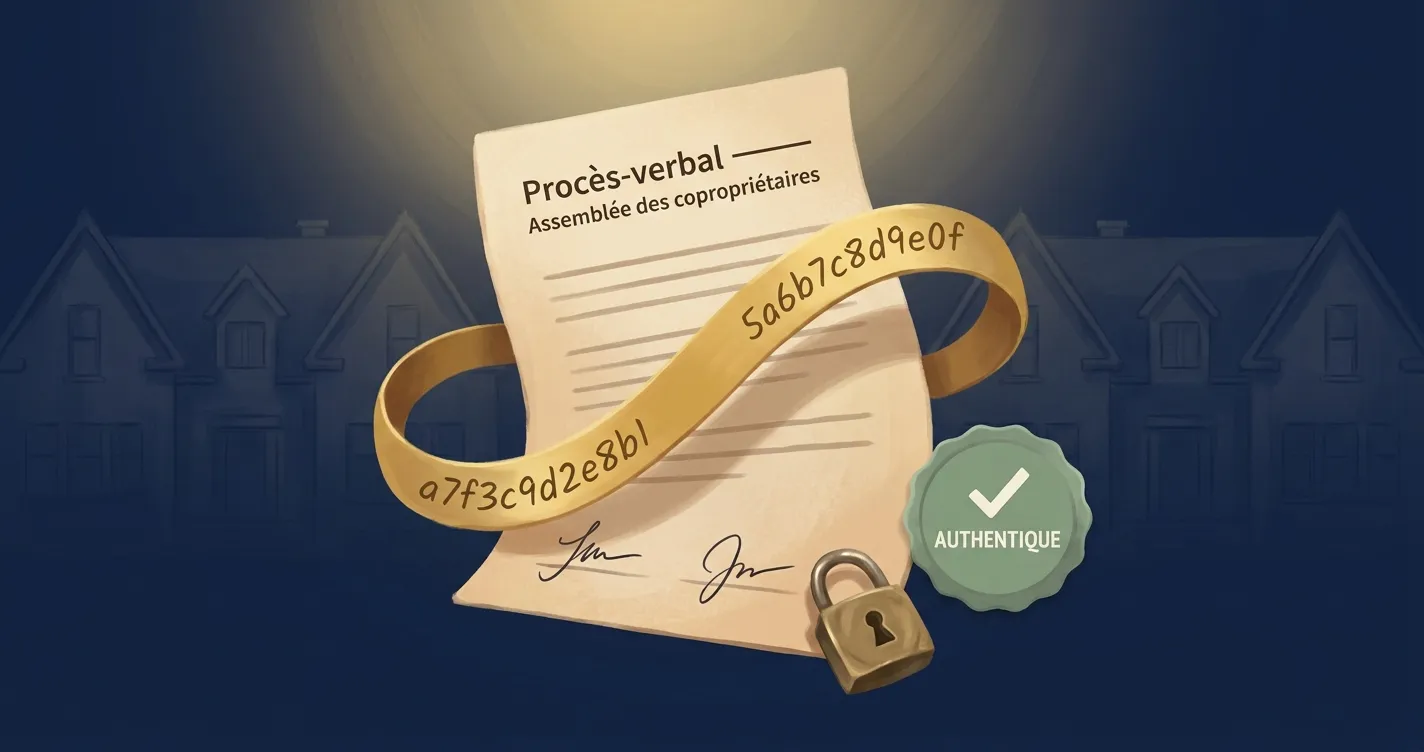
Quick answer: Bill 16 imposes a 30-day deadline to distribute the minutes to every co-owner (article 1102.1 CCQ) and a 90-day window for the cancellation action provided by article 1103. CondoAide generates the minutes, signs them electronically under the LCCJTI, broadcasts them to co-owners as an announcement with open tracking, and stores them in the registry. Servers and backups in Quebec.
What are condo meeting minutes and why do they matter?
The meeting minutes — also called the PV (procès-verbal) — are the official document recording the decisions made during a general meeting of the co-owners or a board meeting. Their value is not symbolic: they constitute the written proof of the syndicate's decisions. When they are signed and stored in accordance with the electronic-signature evidence rules (articles 2827, 2839 and 2840 of the Civil Code of Quebec, read with the LCCJTI), their probative value is firmly established.
Without compliant minutes — signed and delivered on time — the decisions adopted at the meeting may be subject to a cancellation action. Article 1103 CCQ opens this specific avenue: any co-owner may, within 90 days of the meeting, ask the court to annul or modify a decision if it is partial, made with intent to injure, or affected by an error in counting the votes. Other remedies (liability, absolute nullity, etc.) remain open beyond that delay depending on the circumstances.
For most self-managed syndicates in Quebec, the PV is still handled manually: drafted in Word, printed, passed around for handwritten signatures, scanned, then emailed to co-owners individually. This works — when everything goes right. It stops working as soon as a deadline is missed, a signature is forgotten, or a co-owner claims they never received the document.
What are the legal obligations tied to the meeting minutes in Quebec?
The legal framework rests on five main articles of the Civil Code of Quebec, several of which were added or strengthened by Bill 16 (2019).
| Article / Source | Obligation |
|---|---|
| Art. 1070 CCQ | The PV must be kept in the syndicate's registry (CondoAide applies permanent retention by default) |
| Practice (declaration of co-ownership + RGCQ works) | The PV is signed by the chair and the secretary of the meeting. The Civil Code does not specifically prescribe this dual signature, but the practice is universally recognized; it establishes the signer-document link required by CCQ 2827 and the LCCJTI |
| Art. 1102.1 CCQ | The general meeting's PV must be transmitted to every co-owner within 30 days (including absentees) |
| Art. 1086.1 CCQ | The board meeting's PV must be transmitted to the co-owners within 30 days |
| Art. 1103 CCQ | The action to annul or modify a decision of the general meeting must be filed within 90 days of the meeting |
| Art. 337 CCQ | A director may have their dissent recorded in the minutes to limit personal liability |
One last point worth flagging, because it's widely misunderstood: the PV does not have to be "adopted" at the following meeting. It takes effect when the meeting adjourns and becomes final after the 90-day contestation period. Having last year's PV "approved" at the next AGM is a habit inherited from federal law or non-profit associations — not a Bill 16 obligation.
How does CondoAide help produce and distribute the meeting minutes?
CondoAide provides the tools to draft, sign, broadcast, and preserve the PV. The administrator remains responsible for content, for meeting the legal deadlines, and for any additional steps specific to their syndicate.
Wizard-guided generation. The acting administrator opens the PV generator and picks the type: general meeting (annual, extraordinary, reconvened) or board meeting. The wizard pre-fills the syndicate identification, the agenda, the list of co-owners with their voting shares, and offers adaptable resolution templates.
Automatic quorum calculation. The form computes the quorum verdict under the applicable regime (first convocation, adjourned meeting, specific declaration rule). The administrator can confirm or adjust with an explanatory note. For the rule itself — the majority of votes under article 1089 CCQ, not the French regime — see the condo AGM quorum guide, or try the public AGM quorum calculator.
Ready-to-sign PDF. The PDF includes signature zones, the header, the numbered agenda, formatted resolutions with their vote outcome, and a footer showing the date and pagination.
Broadcast to co-owners as an announcement. Once the PV is signed, the administrator can broadcast it to every co-owner via the announcements feature. The PDF is attached to the announcement and sent by email.
Open tracking of the announcement. For each announcement, the administrator sees who opened the email — this is an engagement indicator, useful for following up with people who haven't read it yet. It is not a formal proof of receipt in the legal sense; for that, the administrator can keep their own records (registered mail, hand delivery, etc.) as required.
Storage in the registry. The signed PV is filed in the syndicate's digital registry and remains accessible there.
How does electronic signature of the meeting minutes work?
Electronic signature of the PV complies with the LCCJTI — Quebec's Act to establish a legal framework for information technology. That law, at its article 39, provides that an electronic signature has the same legal value as a handwritten one, on condition that its integrity, its link to the signer, and the moment of signing be demonstrable.
In CondoAide concretely:
- The chair and the secretary of the meeting each receive a signing request by email.
- Three signature styles are available: handwritten (mouse or touch), stylized typed signature, or upload of a signature image.
- The signature library keeps each user's signature after first use — pick it again next time.
- For each signature, the system records the IP address, the user agent, and the timestamp — a complete audit trail that meets the LCCJTI evidentiary requirements.
- Once both signers are authenticated, the PV is locked — a cryptographic SHA-256 hash of the signed document is generated and stored, making any subsequent modification detectable.
For board meeting minutes, the same flow applies, with the added option for a director to have their dissent recorded in the minutes under article 337 CCQ — an important protection against personal liability.
Where are the meeting minutes stored after signing?
Once signed, the PV is automatically filed in CondoAide's digital registry — a registry maintained in accordance with article 1070 of the Civil Code of Quebec, and designed so that document integrity is demonstrable within the meaning of articles 2827, 2839 and 2840 CCQ read with the LCCJTI.
Three principles structure this registry:
Permanent retention (CondoAide policy). The Civil Code does not impose a specific retention period for the PV — it requires only that it appear in the registry. CondoAide applies permanent retention by default: minutes are never deleted, never expire, and survive changes of administrators and plan migrations. Even if an acting administrator leaves the syndicate ten years later, the PV they signed remains accessible.
No mutation possible. Once signed and filed in the registry, the PV cannot be modified — by anyone, not even an administrator. The cryptographic hash of each document allows anyone, at any time, to prove that the content has not been altered since signing. If anyone tried to modify the stored version, the hash would no longer match and the tampering would be detected immediately.
No deletion possible. Where Google Drive lets any administrator with access to the share delete a file — permanently, after 30 days in the trash — CondoAide makes any deletion reversible with a complete time-stamped history. No signed PV can quietly disappear from the registry. Even administrative actions (archival, move) are recorded in the activity log.
It is this combination — permanent retention + cryptographic integrity + activity log — that makes the registry compliant with the preservation obligations Bill 16 and article 1070 impose on the syndicate, and that meets the evidentiary requirements of articles 2827, 2839 and 2840 CCQ read with the LCCJTI.
What does the law say about the 90 days following the meeting?
Article 1103 CCQ grants every co-owner — including those who were absent — a 90-day window from the date of the meeting to file an action to annul or modify a decision adopted there. That action targets specifically decisions that are partial, made with intent to injure, or affected by an error in counting the votes; it is specific to general meetings of the co-owners and has no equivalent for board meetings. Other remedies (civil liability, absolute nullity under articles 1098-1099, challenge of a later board decision) remain open beyond the 1103 delay, depending on the circumstances.
CondoAide does not track those delays in place of the syndicate and does not act as a legal advisor: it is up to the administrator (and, where appropriate, the syndicate's legal counsel) to monitor the applicable deadlines and to assess any ongoing recourse. CondoAide simply keeps the signed PV in the registry, accessible to the people authorized by the syndicate.
How does the administrator distribute the meeting minutes to co-owners?
Article 1102.1 CCQ requires the syndicate to transmit the PV to every co-owner within 30 days — including those who were absent from the meeting. CondoAide offers an announcements feature that streamlines the send.
When ready, the administrator creates an announcement, attaches the signed PV PDF, and sends it to the co-owners registered on the platform. Each co-owner receives the corresponding email.
For each announcement, the dashboard shows who opened the email — this is an engagement indicator (useful for following up with people who haven't read it yet), not a formal legal proof of receipt. An administrator who wants formal proof of receipt can complement the broadcast with the usual means (registered email, hand delivery with acknowledgement, etc.) according to their syndicate's requirements.
For co-owners not registered on CondoAide — for instance, those who prefer to receive their documents by postal mail — the administrator handles distribution by the means they consider appropriate, in parallel with the digital announcement.
Are my data and documents hosted in Quebec?
Yes. The application servers (Vercel — YUL region, Montreal) and the syndicate's main database (Supabase — ca-central-1, Montreal) are hosted in Quebec, and backups are kept there. CondoAide is designed to meet the obligations of Law 25 on the protection of personal information in the private sector.
In practice:
- The minutes, certificates, and the registry are stored and processed in Quebec.
- Some technical subprocessors (subscription billing, transactional email, opt-in AI features) may process some data outside Canada. The full list, the categories of data involved, and the contractual safeguards are in our privacy policy.
- Co-owners benefit from Law 25 protections on the processing of their personal information.
- You can export all your data at any time, in open formats (CSV, PDF), and delete it if you decide to leave the platform.
- In case of service termination, sufficient notice and a complete export are guaranteed to allow a migration without loss.
For notaries reviewing the minutes during a real-estate transaction: the registry documents and their integrity are kept in Quebec, under the applicable legal framework. The document the notary asks for alongside the minutes is the syndicate certificate under article 1068.1 CCQ — and several of its categories (special assessments, planned work, litigation) are read straight out of the minutes of the last three to five years.
Where the minutes sit among the Bill 16 obligations
- Complete guide to Bill 16 — the maintenance logbook, the contingency fund study, and the August 15, 2028 deadline, all decided in a meeting and recorded in the minutes.
- Owner compliance — the five obligations whose tracking table gets attached to the board's minutes.
Frequently asked questions about digital meeting minutes
Are the meeting minutes generated by CondoAide legally valid in Quebec? Yes. The PV meets the Civil Code requirements (articles 1070, 1086.1, 1102.1, 1103) as well as the rules of evidence applicable to signed electronic writings (articles 2827, 2839 and 2840 CCQ read with the LCCJTI). A notice states that the generator produces a template for informational purposes only and does not constitute legal advice.
Must the PV be approved at the next general meeting? No — this is a misconception. The PV takes effect when the meeting adjourns and becomes final after the 90-day contestation period. No approval at the following meeting is required by Bill 16.
What happens if the PV is not distributed within 30 days? The syndicate fails its obligation under article 1102.1 (or 1086.1 for the board). That can expose the directors to personal liability toward the co-owners. Meeting the deadline is the administrator's responsibility; CondoAide provides generation and distribution tools but does not substitute for the syndicate's legal follow-up.
Can the chair and secretary of the meeting sign electronically? Yes. Electronic signatures under the LCCJTI have the same legal value as handwritten ones. Three styles are available (handwritten, typed, uploaded), and the signature is kept in a reusable library.
How long does creating a PV with the wizard take? For a standard meeting, count 20 to 45 minutes depending on the volume of resolutions. Pre-filling of recurring sections (syndicate, co-owners) speeds things up significantly.
Can the PV be modified after signing? No. Once both signatures are applied, the PV is locked by cryptographic hash. Any subsequent modification is detectable. If a correction is needed (e.g., a factual error), a separate addendum must be produced, signed, and filed in the registry.
How much does the PV feature cost? PV generation is available on all plans, including the Free plan (up to 5 units). Signing follows the same model as other documents: 3 signatures per month on Free, unlimited on paid plans starting at $39/month.
What happens to the PV after the 90-day contestation window? The signed PV remains in the registry, accessible to the people authorized by the syndicate, under CondoAide's permanent retention policy. The article 1103 specific recourse window expires on day 91, but other legal remedies (liability, absolute nullity) may remain open depending on circumstances — that assessment belongs to the syndicate and its advisors.
Try the meeting minutes generator for free
The Free plan for up to 5 units gives you access to the generation wizard, the resolution template library, and 3 electronic signatures per month. Import your last meeting and see how generation, signing, and broadcast as an announcement come together in minutes.