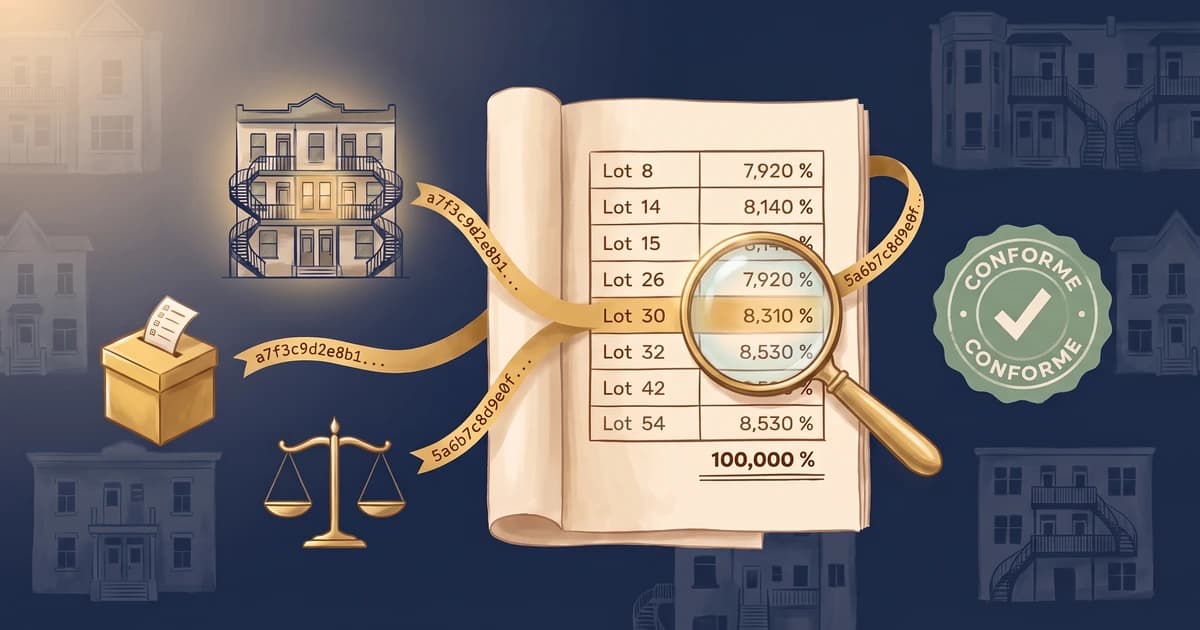
Quick answer: in Quebec, your fraction's relative value is written in the constituting act of your declaration of co-ownership, most often in a table of fractions, in the body of the act or in a schedule (art. 1053 CCQ). It is set according to the nature, destination, dimensions and location of your private portion, without taking its use into account (art. 1041 CCQ). As a general rule, you contribute to the common expenses (art. 1064 CCQ) and hold votes at the meeting (art. 1090 CCQ) in proportion to it.
Where do I find my fraction's relative value?
In the declaration of co-ownership, in its first part, the constituting act. Article 1053 CCQ requires that act to determine the relative value of each fraction, to indicate the method used to set it, and to state each fraction's share of the common expenses and number of votes.
In practice, most notaries present this in a table. It is often announced by a sentence like this one: « Le tableau qui suit indique, pour chaque fraction, la valeur relative, la quote-part des charges communes, le nombre de voix… ». It sits either in the body of the act or in a schedule at the end of the document.
Two checks before relying on it:
- Make sure it has not been replaced. An amending act or a restated declaration may have replaced the original table, for example after a new phase, a subdivision, or a change to the boundaries between two adjoining private portions, which may redistribute their relative values without changing their total (art. 1100 CCQ). The table in force is the one that counts.
- In a phased co-ownership, the initial declaration and the concurrent declarations may each set relative values. See our article on phased co-ownership.
How do I read each column of the table?
Headings vary from one notary to the next, but the same columns come back almost every time.
| Column | What it shows |
|---|---|
| Fraction or lot | The lot number in the Quebec cadastre (for example "2 418 301") or, in older acts, a fraction number. It is the cadastral identifier of your private portion. |
| Unit, address or apartment | The number you use every day. It is not always the lot number. |
| Relative value (« valeur relative ») | Your share of the value of the whole, as a percentage ("8.140 %"), in thousandths or out of 10,000. |
| Share of common expenses (« quote-part des charges communes ») | Your share of the general common expenses. |
| Number of votes (« nombre de voix ») | Your votes at the meeting of co-owners. |
| Share of the common portions | Your share of the undivided ownership of the common portions. |
A few pointers to avoid misreading it:
- The format does not change the value. 830/10,000, 8.3 % and 83 thousandths are the same share.
- The column must add up to the whole. The relative values total 100 %, 1,000 thousandths or 10,000 ten-thousandths. If your sum lands at 99.999 % or 100.001 %, it is often a printed rounding: do not correct the table yourself, note the gap and check each line.
- A parking space can be a fraction. In some co-ownerships each parking space or storage space is a separate fraction with its own lot and relative value. Elsewhere they are restricted common portions with no relative value of their own.
- Not every column is always there. An act may print only a relative-value column and set out the other figures in the text.
Relative value, share and votes: are they the same thing?
Not quite, although the law ties them closely together.
- The share of the common portions is equal to the fraction's relative value (art. 1046 CCQ).
- The contribution to common expenses is in proportion to the relative value (art. 1064 CCQ). An important exception: co-owners who use a restricted common portion alone pay its maintenance and current repairs; the declaration may also allocate major repairs and replacement of those portions differently. See PCUR and relative charges.
- The number of votes is proportional to the relative value (art. 1090 CCQ), subject to the reductions the law provides, for example for a co-owner who holds more than half the votes in a co-ownership of fewer than five fractions (art. 1091 CCQ).
Article 1053 still requires the act to state each of these: the relative value, the share of expenses and the number of votes. So read each column as printed, without deriving one from another. If two columns that should agree do not, raise it with the board of directors, which can consult a notary.
Why is my share higher than my neighbour's?
Because relative value is not calculated on floor area alone. Article 1041 CCQ uses four criteria: the nature, the destination, the dimensions and the location of the private portion.
Two units of the same size can therefore have different values:
- a higher floor, a view or a different orientation (location);
- a commercial unit in a mostly residential building (nature and destination);
- a higher ceiling or a different volume (dimensions are not limited to floor area).
The same article says the relative value is set without taking the use of the unit into account. Whether you live in the unit year-round, rent it out or leave it empty changes nothing.
Article 1053 also requires the act to state the method used to set the relative values. Look for it near the table: it should explain the gap with your neighbour, although some acts merely restate the criteria of article 1041.
Can a relative value be changed?
Rarely, and never by a decision of the meeting alone.
- Within five years of the registration of the declaration, any co-owner may ask the court to revise, for the future, the relative value of the fractions and the allocation of common expenses. The gap must be more than one-tenth compared with the value that should have been set under the declaration's criteria (art. 1068 CCQ).
- The meeting cannot impose it. Any decision of the syndicate that, contrary to the declaration, imposes on a co-owner a change to the relative value of their fraction has no effect (art. 1102 CCQ).
Beyond those cases, the constituting act must be amended: a decision of the meeting by three quarters of the votes of the co-owners present or represented (art. 1097 CCQ), the agreement of the co-owners whose relative value would change (art. 1102 CCQ), then an amending act registered in the land register (art. 1060 CCQ). The syndicate entrusts that file to a notary.
Read your table with a free tool
CondoAide's declaration of co-ownership reader reads the PDF of your declaration and shows you what it finds. It displays the table of fractions as printed, with the page where you can check each line, and says whether the relative-value column adds up to exactly the whole. It also picks out a few basic items: the fiscal year, the number of directors, parking, storage and restricted common portions.
What it does and does not do:
- It corrects nothing and validates nothing. Every value is shown as printed: compare it with the document before using it.
- It does not read every layout. When a table has a shape it cannot read with enough certainty, it says so and points you to the pages to check, rather than inventing values.
- No artificial intelligence service sees the document. It is read by fixed rules, at our hosting providers in Quebec, and the file, its text and the result are deleted 24 hours after upload, or as soon as you ask.
If you administer a syndicate, you can then create your syndicate in CondoAide from that reading. The declaration is filed in the syndicate's register with no second upload, and the board reviews each value, page in hand, before it is used.
To then estimate each unit's contribution from its share, use the condo fee calculator.
Frequently asked questions
Where do I find my condo's relative value? In the constituting act of your declaration of co-ownership, most often in a table of fractions, sometimes in a schedule (art. 1053 CCQ). If an amending act replaced that table, the new one applies. The declaration is part of the register the syndicate keeps available to co-owners (art. 1070 CCQ).
Is the relative value calculated on floor area? Not only. The law looks at the nature, destination, dimensions and location of the private portion, without taking its use into account (art. 1041 CCQ). Two units of the same size can therefore have different relative values.
Is my share of common expenses always equal to my relative value? As a general rule, each co-owner contributes to common expenses in proportion to the relative value of their fraction (art. 1064 CCQ). The maintenance and current repairs of a restricted common portion are, however, paid by its users alone.
Is my number of votes equal to my relative value? It is proportional to it (art. 1090 CCQ), unless the law reduces it, for example for a co-owner who holds more than half the votes in a co-ownership of fewer than five fractions (art. 1091 CCQ).
Can the meeting change my relative value? No, not against your will. A decision of the syndicate that imposes a change to your fraction's relative value contrary to the declaration has no effect (art. 1102 CCQ). Within five years of the registration of the declaration, a revision can be sought in court (art. 1068 CCQ).
Further reading
- Civil Code of Québec, art. 1041 - criteria for relative value
- Civil Code of Québec, art. 1053 - contents of the constituting act
- Civil Code of Québec, art. 1068 - revision by the court
- Declaration of co-ownership reader - free tool
- PCUR and relative charges: who pays what in a Quebec condo?
- Calculating the quorum of a condo AGM
- Phased co-ownership: initial and concurrent declarations
This article provides general information and is not legal advice. For a decision that binds the syndicate, or a request for revision, consult your notary or your lawyer. CondoAide is a management platform: the declaration reader shows you what is printed, it does not interpret the declaration.