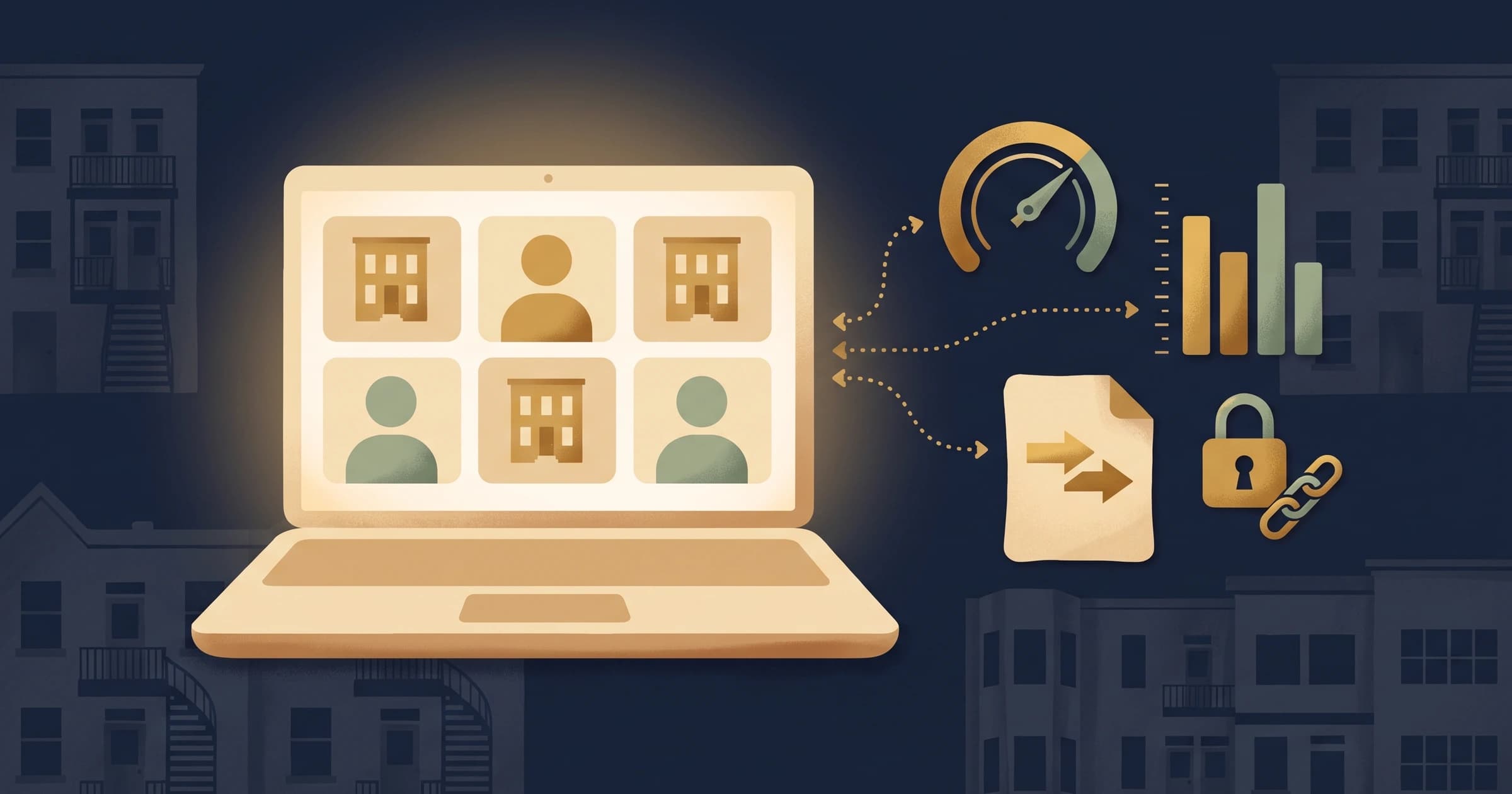
The community room is booked, the coffee is ready, and out of the building's 48 units, 9 co-owners show up. No quorum. You adjourn, reconvene, and start over a month later. This is the single most common reason annual meetings stall in Quebec, and it is exactly what the virtual meeting is built to fix.
The Civil Code of Quebec now explicitly allows condo meetings by technological means. Video conferencing is no longer a pandemic workaround: it is a recognized way to hold a meeting, as long as you respect two or three precise rules. Here is how to run a remote AGM that is both better attended and fully compliant.
Quick answer
In Quebec, a condo meeting can be held entirely by video, provided all participants can communicate immediately with each other (art. 1088.1 CCQ). Electronic voting is permitted if the votes can be verified afterward and remain secret when a secret ballot is requested (art. 1089.1 CCQ). Quorum and majorities are counted in votes (relative value), not by headcount — the AGM quorum calculator gives that verdict as you enter attendance. A platform like CondoAide brings the video, live quorum, weighted voting and minutes together in one place.
Is a virtual meeting actually legal in Quebec?
Yes, without ambiguity. Article 1088.1 of the Civil Code provides that a meeting of the co-owners may be held using a means that allows all participants to communicate immediately with each other. Video conferencing fits precisely: everyone can see, hear and speak in real time.
The key condition is simultaneous, two-way communication. A plain webinar where co-owners listen without being able to intervene is not enough. That is why a real meeting room, with microphones, raised hands and speaking rights, beats a one-way broadcast.
The meeting can also be hybrid: some co-owners in a room, the rest online, everyone in the same session. That format often draws the biggest crowd, because it excludes no one.
Live quorum: counted in votes, not heads
Quorum is the attendance threshold required for the meeting to deliberate validly. Article 1089 CCQ sets it at the majority of votes: the meeting has quorum when co-owners holding more than 50% of the votes are present or represented.
Watch the classic trap: quorum is not counted in people. Each unit holds a number of votes proportional to its relative value, the well-known share ("quote-part") set out in the declaration of co-ownership (art. 1090 CCQ). A penthouse at 3.4% carries more weight than a studio at 0.7%.
Over video, this calculation becomes an asset rather than a headache. As co-owners join the session, quorum updates live: the platform adds up the votes of those present and of proxies, and shows the percentage reached. The chair then confirms the figure, exactly as they would with a paper attendance sheet. We break down the mechanics in our guide to calculating quorum.
What if quorum is not reached?
The Civil Code provides for a second call. If the first meeting lacks quorum, a second is convened; at that new meeting, quorum is constituted by three-quarters of the members present or represented (art. 1089 CCQ), a far easier bar to clear in practice. Note that a decision requiring a three-quarters majority (art. 1097 CCQ) can only be taken there if those members represent at least the majority of the votes of all co-owners. The notice of meeting can announce both dates in advance, which avoids a month's delay. Online, the second call costs even less to organize: no room to re-book, just a new link.
Proxies: the real engine of participation
An absent co-owner is not a lost vote. They can give a written proxy to be represented at the meeting. In Quebec, they can appoint another co-owner, a family member or any other person of their choice, unless the declaration of co-ownership says otherwise.
This is often what separates a meeting that sits from one that collapses. In a 30-unit building, 5 or 6 well-collected proxies are regularly enough to clear the quorum threshold.
A modern virtual meeting handles proxies end to end:
- The absent co-owner designates their proxyholder ahead of time, straight from their profile.
- An external proxyholder, who is not a co-owner, can be invited to vote on behalf of the person they represent, without access to the rest of the syndicate's file.
- Delegated votes are added automatically to the right tally, and the minutes keep a record of who represented whom.
That last point matters: a poorly recorded proxy is one of the errors that can undermine a decision.
Weighted electronic voting, with no paper and no math errors
This is where video pulls ahead of the physical room. Article 1089.1 CCQ allows voting by technological means under two strict conditions:
- Votes must be collected in a way that lets them be verified afterward.
- They must remain secret when a secret ballot is requested.
A good platform meets both without compromise. Each fraction votes with its exact weight in relative value, proxies included. The count is instant and weighted: no more manual tally of 10,000 votes spread across 60 units, no more risk of an addition error.
Each decision has its own majority
Quorum lets the meeting sit; after that, each resolution requires a precise level of majority. The platform automatically applies the right threshold based on the type of decision:
| Type of decision | Required majority |
|---|---|
| Election of directors, amending the building by-laws, ordinary resolutions | Majority of the votes of the co-owners present or represented (art. 1096 CCQ) |
| Major work, acquisitions, changes to the constituting act | Three-quarters majority of the votes (art. 1097 CCQ) |
| Change of destination of the immovable | 3/4 of the co-owners holding 90% of the votes (art. 1098 CCQ) |
The weighted count avoids the most dangerous error: a miscalculated vote. Article 1103 CCQ lets a co-owner ask for a decision to be annulled within 90 days, notably in the case of an error in counting the votes. An auditable count that can be verified afterward is therefore far more than a convenience: it is protection.
The verifiable secret ballot
Electing directors or settling a sensitive question may call for a secret ballot. The paradox of electronic voting is having to be both secret and verifiable. CondoAide solves it by separating identity from choice: the co-owner receives a receipt that lets them confirm their vote was recorded, without anyone, not even the syndicate, being able to link their name to their choice.
From the vote to the minutes, with no re-keying
Once the meeting is adjourned, the minutes still have to be written. That is often the chore that drags on for weeks.
When the meeting was held online, the data is already there: confirmed attendance, quorum reached, resolutions debated and weighted vote results. CondoAide uses these to pre-fill the minutes, which the chair and secretary only need to review and sign electronically. The syndicate remains responsible for the content and for transmitting it within the legal deadlines; the tool speeds up the drafting, it does not replace the board's judgment. For everything on the document's legal value, see our guide to minutes and Bill 16.
Not just the AGM: the board of directors too
The same mechanics serve board of directors meetings. A board sitting remotely gets live quorum, voting and minute generation, without having to gather everyone around a table on a Tuesday night. For volunteer directors with busy schedules, that is often the difference between a board that meets and one that postpones.
Where does your meeting data go?
A virtual meeting means video, names and votes: personal information within the meaning of Law 25. CondoAide has designated a person responsible for the protection of personal information, publishes its governance policies, and hosts its data in Quebec: application on Vercel in Montreal, Supabase database in Montreal (ca-central-1), and meeting video served from a server located in Quebec. Some technical sub-processors (payments, email, artificial intelligence) may process certain data outside Canada; the details are in the privacy policy. For a syndicate, this local-hosting choice is an increasingly sought-after digital-sovereignty argument.
Key takeaways
- The condo meeting by video is allowed in Quebec (art. 1088.1 CCQ), as long as everyone can communicate at the same time.
- Quorum is counted in votes (relative value), not in people, and updates live as attendees join.
- Proxies, including to an external proxyholder, count toward quorum and voting, and must be recorded correctly.
- Electronic voting must be verifiable and secret on request (art. 1089.1 CCQ); a weighted, auditable count guards against the annulment set out in art. 1103.
- The minutes are drafted from the session's results, which eliminates re-keying.
Is your next meeting coming up? Hold your AGM by video with CondoAide and stop chasing quorum.