Run your condominium corporation, with Ontario rules built in
Owner requests, notices, owners' meetings and the corporation's records, in one place, for volunteer boards and the small managers who work with them. Status certificates, information certificates and records requests come out on the CAO's forms, filled from those records.
- Free for corporations with 5 units or fewer
- Already used by condo boards in Quebec
- Built in Canada
When is the status certificate due?
A buyer, an owner or a lender asked for a status certificate. Enter the dates to see when the corporation has to give it.
Enter the day the request arrived to see the due date.
Condominium Act, 1998, s. 76 (3), (5) and (6); O. Reg. 48/01, s. 18 (4); Legislation Act, 2006, ss. 88-89. General information, not legal advice. The tool counts Sundays and the named holidays, not a day proclaimed a holiday, which also extends the time. The board remains responsible for giving the certificate on time.
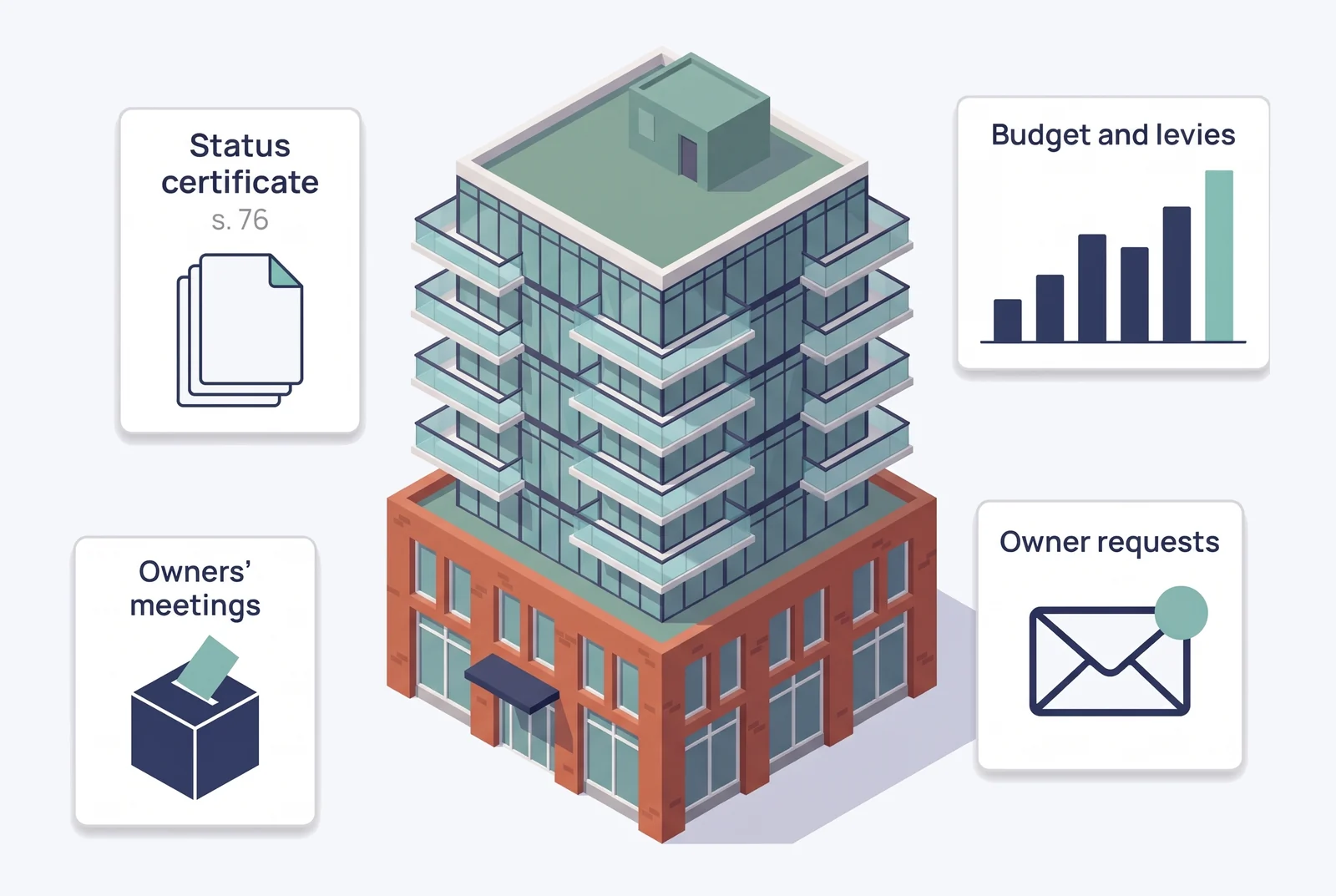
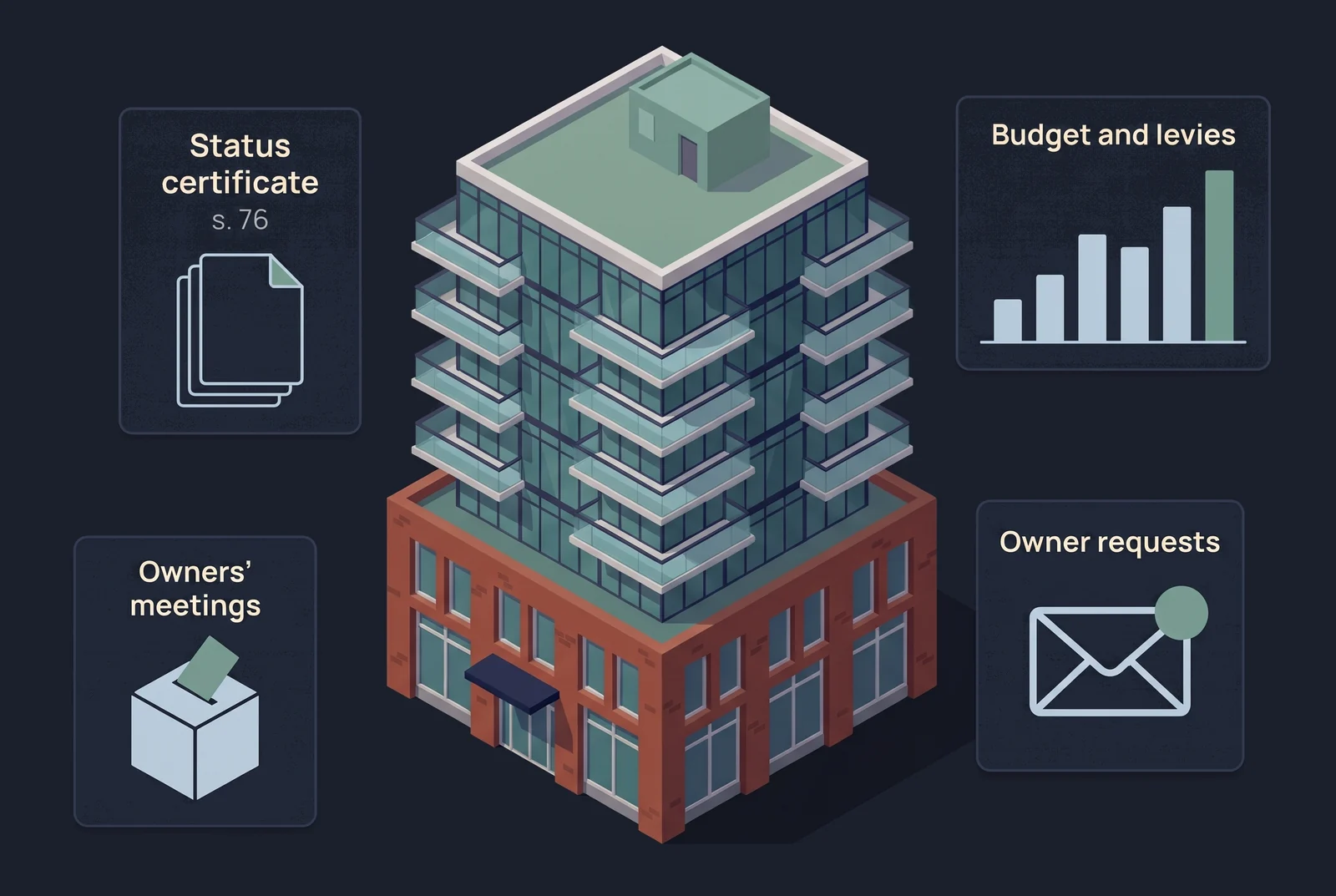
Run the corporation
The work a board does every week, for every owner, without a pile of email threads and spreadsheets.
Owner requests
Owners send requests and questions from their own access. The board answers each one and follows it to the end, and the history stays with the unit.
Notices and messages
Send a notice to every owner by email, and see who has opened it.
Owners' meetings
Prepare the notice and the agenda, collect proxies on the CAO's form, and hold the meeting in person, online or both, as your by-laws allow.
Records and documents
The declaration, by-laws, rules, minutes, budgets and insurance in one place, with access set role by role.
Owner obligations
Ask owners for proof of insurance, smoke and carbon monoxide alarm tests and the other duties in your declaration, by-laws and rules, and see who has answered.
Budget and levy notices
Prepare the budget and send each owner the common expenses for their unit. Owners pay the corporation directly, as they do today.
Built on the Condominium Act, 1998
The certificates, notices and responses an Ontario board owes, on the CAO's forms where the law prescribes one, filled from the corporation's records.
- Status certificates
- Prepare the certificate on the CAO's form, with the unit's figures taken from your records. The corporation gives it within 10 days after the request and the fee.Condominium Act, 1998, s. 76; O. Reg. 48/01, s. 18
- Information certificates
- Periodic information certificates, updates and new owner certificates, built from the same records.Condominium Act, 1998, s. 26.3; O. Reg. 48/01, ss. 11.1-11.3
- Records requests
- Receive an owner's request on the CAO's form and answer it on the board response form. Records disputes were 179 of the 371 cases the Condominium Authority Tribunal accepted in 2025-26 (CAO Annual Report 2025-26).Condominium Act, 1998, s. 55; O. Reg. 48/01, ss. 13.3-13.8
- Reserve fund
- Each reserve fund study, the board's funding plan and the Notice of Future Funding kept together, study after study. The study itself is done by one of the professionals the regulation names, never a director, an officer or the property manager.Condominium Act, 1998, s. 94; O. Reg. 48/01, ss. 27-33
- Proxies and voting
- Proxies on the CAO's form, and electronic voting, which the Act allows unless your by-laws restrict it.Condominium Act, 1998, ss. 45-52
- Director training
- Keep each director's CAO training on record. A new director has six months from their election or appointment to complete it.Condominium Act, 1998, s. 29 (2) (e); O. Reg. 48/01, s. 11.7
Pricing
One price per corporation, by its number of units. Nothing to install.
At a glance: Free $0 · Starter from $24 · Management from $39 · Pro from $69 per month, before taxes, depending on the syndicate’s size (up to 15 units, 16-30 units, 31 units and up). Above 50 units: $1, $1.50 or $2 per additional unit per month. Two months free on annual plans. For plan prices and limits, only dwellings and commercial premises count as units; garages, parking spaces and storage lockers do not.
Free for corporations with 5 units or fewer. Taxes extra.
Manage several corporations? See the property manager plan
Guides for Ontario condo boards
Plain-language guides grounded in the Condominium Act, 1998, with the section behind every rule. Free to read, with or without an account.
When is a periodic information certificate due in Ontario?
Ontario condo boards send a periodic information certificate twice a year, within 60 days after the first and third quarters. What it must contain, and the ICU and NOIC.
What must an Ontario board do after a reserve fund study?
After a reserve fund study, an Ontario condo board has 120 days to propose a funding plan and 15 days to send the Notice of Future Funding. The full cycle, step by step.
Can an Ontario condo hold a virtual AGM without a by-law?
Since October 1, 2023, Ontario condo meetings and votes may be held by telephonic or electronic means unless the by-laws restrict them. The rule, quorum and records.
Condo arrears in Ontario: when does the lien expire?
An Ontario condo lien expires three months after the default unless a certificate of lien is registered, with 10 days' notice to the owner first. A treasurer's guide to the clock.
How do you run a self-managed condo corporation in Ontario?
A self-managed Ontario condo board's recurring legal duties on one calendar: AGM, information certificates, annual return, reserve fund study, records, training and licensing.
Looking for a short answer to one question? Read the Ontario blog
Questions
Can my corporation use CondoAide today?
Yes. Create an account, then create your corporation and choose Ontario. Its modules follow the Condominium Act, 1998 and use the CAO's forms.
Is CondoAide a condominium manager?
No. CondoAide is software for the board. It does not replace a licensed condominium manager, a lawyer or an auditor, and it never collects or holds the corporation's money.
Can owners pay their common expenses through CondoAide?
Not in Ontario. Owners pay the corporation the way they do today; CondoAide prepares the budget and the notices that tell each owner what they owe.
Does CondoAide prepare the reserve fund study?
No. Only the professionals the regulation names may conduct a reserve fund study. CondoAide keeps each study, the funding plan and the Notice of Future Funding together.