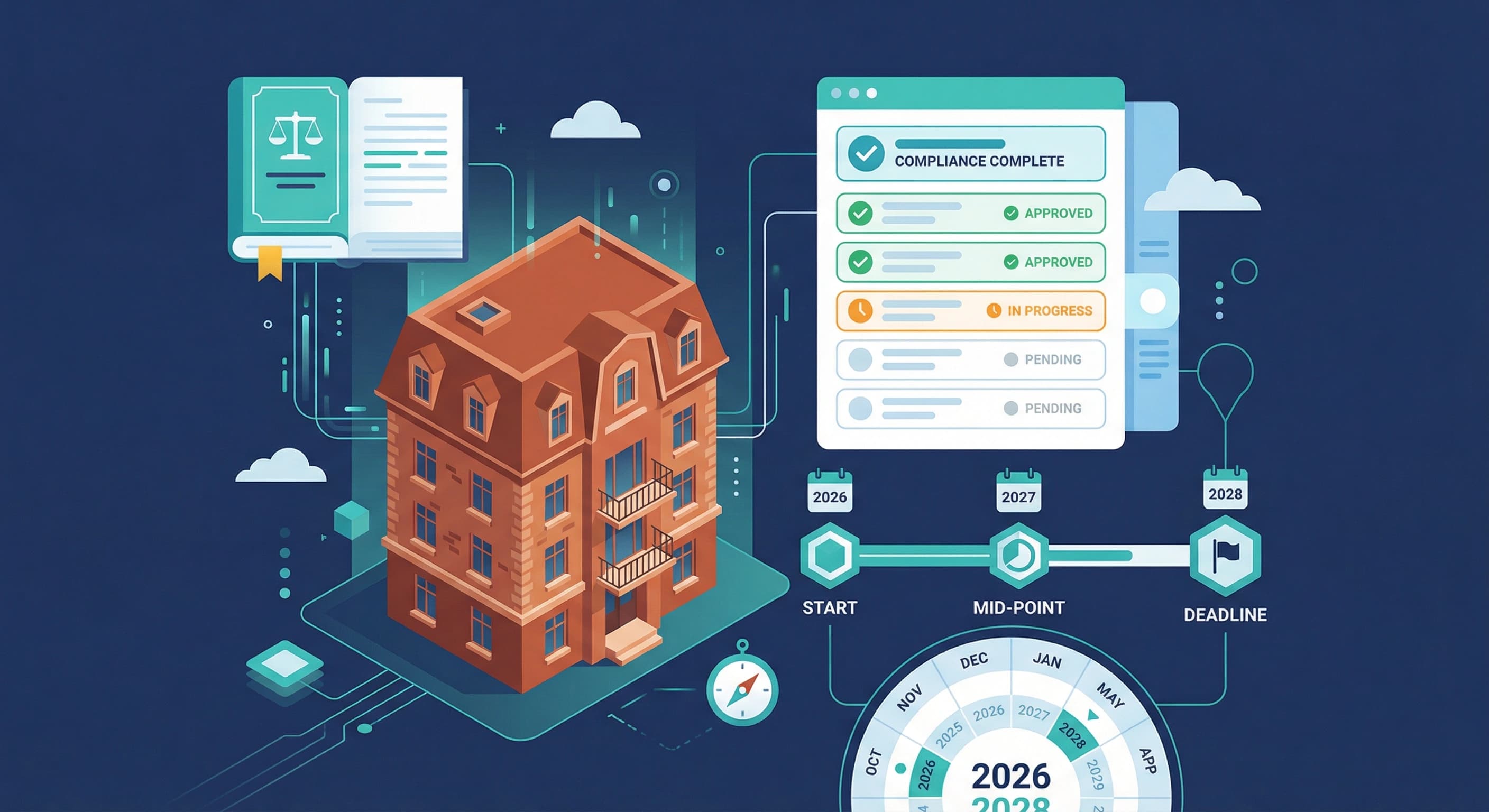
Bill 16 (Loi 16), adopted in 2019, represents the most significant reform to Quebec's co-ownership legal framework in decades. It amends the Code civil du Québec (articles 1038 to 1109) to improve the management and transparency of condo syndicates.
Critical deadline: August 15, 2028 - the date by which every Quebec co-ownership must have obtained its first maintenance logbook and first contingency fund study. Bill 16, s. 151 gives three years and one day from the regulation's entry into force (August 14, 2025). The obligations themselves are already in force.
This guide covers everything you need to know to ensure your syndicate meets its obligations.
The Implementing Regulation
Bill 16's implementing regulation is the Règlement établissant diverses règles en matière de copropriété divise, adopted under decree 991-2025, published in the Gazette officielle du Québec, Part 2, on July 30, 2025 (vol. 157, no. 31, p. 4643). Its section 15 sets entry into force at the fifteenth day after publication: July 30 + 15 = August 14, 2025.
The regulation is not attestation-only. Its Division I governs the maintenance logbook (ss. 1-6), Division II the contingency fund study (ss. 7-9), Division III the syndicate certificate (s. 10), and Division IV the protection of deposits paid on the purchase of a new fraction (ss. 11-13).
Where the 5-year rule actually lives
Since Bill 31 (2024), the frequency of the contingency fund study is no longer in the Civil Code. Section 2 of that Act struck the words « Tous les cinq ans, » from the second paragraph of article 1071 and replaced them with a reference to the regulation, which "determines how often a new study must be obtained by the board of directors".
The regulation put the same figure straight back: "Une étude du fonds de prévoyance doit être obtenue par le conseil d'administration minimalement tous les 5 ans" (Decree 991-2025, s. 8). The five-year cadence was not abolished, it changed vehicles, moving from statute to regulation. For a syndicate, the obligation is identical. The distinction matters because the frequency can now be changed by regulation, without going through the National Assembly.
Bill 31 also added that the standards set by regulation "may vary according to the characteristics of an immovable", at article 1070.2 for the maintenance logbook (Bill 31, s. 1) and at article 1071 for the study (s. 2). That is what authorizes the accommodations described below for small buildings.
Should you wait for the rules to soften?
No. Many boards delay ordering the logbook or the study on the assumption that Québec will eventually back down. There was one attempt, and it failed.
Bill 20, tabled under the previous legislature, would have introduced a power to exempt syndicates from precisely these two obligations: the maintenance logbook and the contingency fund study. The RGCQ opposed it in parliamentary committee, pointing out the incoherence of allowing an exemption from one tool (the logbook) that the other (the study) directly depends on. In June 2026 the government announced it would not bring the bill back.
In practice: the Bill 16 obligations survived the only serious attempt to soften them, and they apply today as written. A future bill could revisit the question - the government has signalled further housing work - but planning around a relaxation that does not exist only shortens the time you have left before 15 August 2028.
Frequencies, section by section
Every one of these frequencies is set by the regulation, not by the Civil Code:
| Obligation | Frequency | Source |
|---|---|---|
| Contingency fund study | at least every 5 years; projected over at least 25 years | Decree 991-2025, s. 8 |
| Maintenance logbook: professional revision | at least every 5 years; every 10 years for eligible buildings | Decree 991-2025, s. 5 |
| Maintenance logbook: board update | at least once a year | Decree 991-2025, s. 4 |
| Syndicate certificate | on request, within 15 days | C.C.Q., art. 1068.1, para. 2 |
The Three Pillars of Bill 16
Bill 16 imposes three major obligations on all divided co-ownership syndicates in Quebec:
1. The Maintenance Logbook (article 1070.2 CCQ)
A mandatory document that records the history and condition of the building, including:
- Technical characteristics of the building
- History of maintenance and repair work
- Current condition of major components
- Planned work and recommendations
Regulation in force since: August 14, 2025. Deadline for existing co-ownerships to have obtained a compliant logbook: August 15, 2028 (Bill 16, s. 151 - three years and one day after the regulation came into force).
2. The Contingency Fund Study (articles 1071-1072 CCQ)
A professional analysis that determines:
- Financial needs over a minimum 25-year horizon
- Recommended annual contribution amounts
- Projections for major expenditures
- Current state of the fund
Deadline to have obtained the first study: August 15, 2028 (Bill 16, s. 151).
3. The Syndicate Certificate (article 1068.1 CCQ)
A document provided to any seller that discloses:
- The state of the contingency fund
- Current or planned special assessments
- Planned major work
- Ongoing litigation
- Compliance with studies and recommendations
In effect since: August 14, 2025 (ALREADY IN FORCE)
Who Is Affected by Bill 16?
ALL co-ownerships are affected
Myth to debunk: "My small 4-unit condo doesn't need to comply."
Reality: Bill 16 applies to ALL divided co-ownerships in Quebec, with no exceptions based on size. Whether you have 3 units or 300 units, you must comply.
Exceptions and Accommodations
Certain buildings benefit from extended timelines or reduced requirements:
Buildings eligible for the 10-year revision cycle. The accommodation does not turn on the year of construction or on unit count alone. The regulation targets a building that meets any one of these three conditions (Decree 991-2025, s. 5, para. 2):
- it has at most 8 private portions, excluding those that are accessory (storage and parking spaces);
- no common portion of the building is located inside a building;
- it has at most 3 storeys entirely above ground.
For those buildings, the professional revision of the maintenance logbook is required at least every 10 years instead of every 5. The board's annual update and the contingency fund study requirements are unchanged.
Co-ownerships coming out of developer control:
- Within 30 days of the special meeting held after the developer loses control, the developer must hand the syndicate both the maintenance logbook and the contingency fund study (article 1106.1 CCQ). That meeting must itself be called within 90 days of the developer losing the majority of votes (article 1104 CCQ).
- Until the developer obtains the study, contributions to the contingency fund must equal 0.5% of the building's reconstruction value (article 1071 CCQ, last paragraph).
The Maintenance Logbook in Detail
What Must the Logbook Contain?
The maintenance logbook must document:
Section 1: Building Characteristics
- Construction date and history
- Original plans and specifications
- Technical specifications of systems
- List of major components
Section 2: Component Condition For each major component:
- Current condition (good, acceptable, deteriorated)
- Estimated remaining useful life
- Planned replacement date
- Estimated replacement cost
Section 3: Maintenance History
- Preventive maintenance work performed
- Major repairs completed
- Invoices and service contracts
- Inspection reports
Section 4: Planning
- Preventive maintenance schedule
- Recommended short-term work (1-3 years)
- Planned medium-term work (3-10 years)
- Major long-term work (10-25 years)
Who Can Prepare the Logbook?
Initial preparation: Must be carried out by a professional member of:
- OIQ (Ordre des ingénieurs du Québec)
- OAQ (Ordre des architectes du Québec)
- OTPQ (Ordre des technologues professionnels du Québec)
- OEAQ (Ordre des évaluateurs agréés du Québec)
The professional must be independent (no conflict of interest with the syndicate).
Annual updates: The board of directors must update the logbook at least once a year (Decree 991-2025, s. 4)
- Adding new invoices and contracts
- Updating maintenance history
- Revising the work schedule
Professional revisions: At least every 5 years, or every 10 years for eligible buildings (Decree 991-2025, s. 5). Only a person meeting the same conditions as the one who established the logbook may revise it.
Typical Maintenance Logbook Costs
Costs vary depending on the size and complexity of the building:
| Building Size | Estimated Cost |
|---|---|
| 3-6 units (triplex/quadruplex) | $2,000 - $4,000 |
| 7-15 units | $4,000 - $7,000 |
| 16-30 units | $7,000 - $12,000 |
| 31-50 units | $12,000 - $18,000 |
| 51+ units | $18,000+ |
Budgeting tip: Plan for this cost now in your 2026-2027 budget.
The Contingency Fund Study
Why a Study Is Necessary
The contingency fund (fonds de prévoyance) finances major repairs and the replacement of common areas. Without adequate planning, syndicates face:
- Emergency special assessments (thousands of dollars per unit)
- Deferred essential work (accelerated deterioration)
- Decreased property values
- Financing difficulties (banks reluctant to lend without reserves)
Contents of the Study
The contingency fund study must include:
Component Inventory
- Identification of all common areas
- Classification by importance and cost
Condition Analysis
- Assessment of the current condition of each component
- Estimated remaining useful life
- Replacement priorities
Financial Projections (25-year minimum)
- Schedule of planned replacements
- Estimated costs with inflation
- Annual contribution requirements
Recommendations
- Target contingency fund balance
- Recommended annual contributions
- Catch-up strategy if the fund is insufficient
Who Can Conduct the Study?
The study must be prepared by (Decree 991-2025, s. 7):
- A member of the OIQ, OAQ, OTPQ, or OEAQ meeting the conditions of s. 1 of the regulation (professional activities mainly in property management, construction, renovation, appraisal or inspection, and independent of the syndicate)
- OR a member of the Ordre des comptables professionnels agréés du Québec (CPA) meeting that same independence condition
The CPA is authorized for the contingency fund study only - not for the maintenance logbook.
Typical Study Costs
| Building Size | Estimated Cost |
|---|---|
| 3-6 units | $3,000 - $5,000 |
| 7-15 units | $5,000 - $8,000 |
| 16-30 units | $8,000 - $15,000 |
| 31-50 units | $15,000 - $25,000 |
| 51+ units | $25,000+ |
Update Frequency
- New study: The board must obtain one at least every 5 years (Decree 991-2025, s. 8)
- Early study: Recommended after major work, or whenever the logbook's replacement schedule shifts materially
- Note: the annual update obligation applies to the maintenance logbook (s. 4), not to the study
The Syndicate Certificate
When Is It Required?
The syndicate certificate is required by law on the sale of a unit: the seller must obtain it from the syndicate and hand it to the promissory buyer (article 1068.1 CCQ). Financial institutions also commonly ask for it on a mortgage or refinancing, but that is a lender requirement, not a statutory one.
Mandatory Contents
The certificate must disclose:
Financial Information
- Current contingency fund balance
- Current annual contributions
- Past, current, or planned special assessments
- Compliance with the contingency fund study recommendations
Work and Maintenance
- Major work completed in the past 5 years
- Major work planned for the next 10 years
- Estimated costs and planned financing
Legal Matters
- Ongoing litigation to which the syndicate is a party and that is before a court
- Claims that have affected the unit being sold or the common portions in the past 5 years
- Amendments made to the declaration of co-ownership in the past 3 years
Insurance
- Details of the syndicate's insurance coverage
- Deductible amount
- Claims history
Delivery Timeline
The syndicate must provide the certificate within 15 days of the co-owner's request (article 1068.1, para. 2 CCQ).
Important for sellers: Request the certificate at least 3 weeks before signing the offer to purchase to avoid delays.
Board of Directors' Responsibility
The board must:
- Maintain up-to-date records to be able to issue the certificate promptly
- Ensure the information provided is accurate and complete
- Designate a person responsible for processing requests
Warning: Providing false or incomplete information can expose the syndicate and its directors to liability.
For the practical detail of the certificate — the eight categories, the request template, and the issuing procedure — see the complete guide to the syndicate certificate.
What Bill 16 Also Changed for Meetings and for Co-owners
The three obligations above are the ones that carry a deadline. Bill 16 also tightened two things that come round every year.
Minutes must now be circulated within 30 days. Article 1102.1 CCQ requires the syndicate to send the minutes of a general meeting to every co-owner — absentees included — within 30 days, and article 1086.1 sets the same deadline for board meetings. For the deadlines, the signature, and registry retention: condo meeting minutes.
Every co-owner must now carry civil liability insurance. Article 1064.1 CCQ, added by Bill 16, imposes that cover on each co-owner. In practice the syndicate has to track it alongside four other recurring obligations: owner compliance — insurance proof, air duct cleaning, private plumbing, smoke alarm, and water heater.
Compliance Timeline 2026-2028
Already in Effect (since August 2025)
✅ Maintenance Logbook regulation
- The standards apply to every syndicate, with no size exception
- Existing co-ownerships have until August 15, 2028 to have obtained a compliant logbook (Bill 16, s. 151)
- Once obtained: annual updates by the board (s. 4), professional revision on the required schedule (s. 5)
✅ Syndicate Certificate
- Mandatory for all sales
- 15-day delivery deadline
Deadline to obtain the first documents: August 15, 2028
⏰ Contingency Fund Study
- All syndicates must have a complete study
- Minimum 25-year projections
- A new study at least every 5 years thereafter (Decree 991-2025, s. 8)
Recommended Action Plan for 2026
First quarter 2026 (NOW)
- [ ] Verify whether your maintenance logbook is compliant
- [ ] If not compliant, contact a qualified professional
- [ ] Budget for the contingency fund study
Second quarter 2026
- [ ] Obtain proposals for the contingency fund study
- [ ] Approve the mandate at the annual general meeting (AGM)
- [ ] Engage the professional
Third-fourth quarter 2026
- [ ] Completion of the contingency fund study
- [ ] Presentation of results to the board
- [ ] Plan for contribution adjustments
Early 2027
- [ ] Presentation of the study at the 2027 AGM
- [ ] Vote on contribution adjustments
- [ ] Implementation of the funding plan
Consequences of Non-Compliance
Legal Risks
Director Liability
- Directors may be held personally liable
- Lawsuits by co-owners are possible
- Insurance claims may be denied
Disputes with Co-Owners
- Challenges to board decisions
- Requests for director removal
- Potential class-action lawsuits
Impact on Transactions
Unit Sales
- Transaction delays
- Buyers withdrawing from deals
- Reduced sale prices
- Financing difficulties for buyers
Property Values
- Decreased attractiveness of the building
- Negative market perception
- Unfavorable comparisons with compliant buildings
Administrative Sanctions
Although rare, sanctions can be imposed:
- Potential fines
- Compliance injunctions
- Negative publicity
Frequently Asked Questions (FAQ)
Does my small 4-unit condo really have to comply with Bill 16?
Yes, absolutely. Bill 16 applies to all divided co-ownerships in Quebec, regardless of size. Even a 3-unit triplex must comply. Small buildings do benefit from one accommodation: where the building has at most 8 private portions (excluding storage and parking), has no common portion located inside a building, or has at most 3 storeys entirely above ground, the maintenance logbook is revised at least every 10 years instead of every 5 (Decree 991-2025, s. 5, para. 2).
How often must the contingency fund study be redone?
At least every 5 years. Since Bill 31, that frequency is no longer in the Civil Code: it is set by section 8 of the regulation adopted under decree 991-2025. The five-year cadence was not abolished, it simply changed legislative vehicles.
How much does full compliance cost?
For a typical 10-unit building:
- Initial maintenance logbook: $4,000 - $7,000
- Contingency fund study: $5,000 - $8,000
- Total: $9,000 - $15,000 (one-time cost)
Per unit: approximately $900 - $1,500 as a one-time cost.
Plan these costs over 2-3 years to spread the impact on the budget.
What happens if we miss the August 15, 2028 deadline?
After August 15, 2028, a syndicate without a contingency fund study will be in non-compliance with the Code civil. This can lead to:
- Increased director liability
- Difficulties during sales (reluctant buyers and banks)
- Disputes with co-owners
- Inability to provide complete syndicate certificates
Recommendation: Do not wait until the last minute. Qualified professionals will be in very high demand in 2027-2028.
Who pays for the maintenance logbook and contingency fund study?
The syndicate of co-owners pays these costs, funded through the operating budget or the contingency fund. Costs are shared among all co-owners according to their respective fractional shares.
These expenses are considered mandatory common charges, just like insurance or regular maintenance.
Our maintenance logbook was prepared in 2024. Is it still valid?
Yes. A logbook obtained by the board in the 2 years before the regulation came into force (so between August 14, 2023 and August 14, 2025) stays valid for 5 years from the date it was obtained - 10 years for the eligible small buildings above - provided the person who prepared it met the regulation's conditions (Decree 991-2025, s. 14). Meanwhile you must:
- Update it at least once a year (by the board)
- Have it professionally revised on the required schedule (5 or 10 years)
Can we use the contingency fund to pay for the study?
Yes, this is even recommended. The contingency fund study is an expense related to the management of common areas. It can legitimately be funded from the existing contingency fund.
However, if your fund is insufficient, it may be necessary to budget this expense in the operating charges.
Our building was constructed in 2022. Are we exempt?
No. The developer was required to hand your syndicate both the maintenance logbook and the contingency fund study within 30 days of the special meeting held after losing control (article 1106.1 CCQ). Verify that you received both, and that the study was prepared by someone meeting the regulation's conditions.
Once you have a compliant study, the board must obtain a new one at least every 5 years (Decree 991-2025, s. 8).
How do I choose a qualified professional?
Selection criteria:
- Certification: Active member of the OIQ, OAQ, OTPQ, or OEAQ
- Experience: Specialization in co-ownership (ask for references)
- Insurance: Professional liability insurance coverage
- Independence: No conflict of interest with the syndicate
- Portfolio: Experience with buildings similar to yours
Recommended process:
- Obtain 2-3 detailed proposals
- Check references with other syndicates
- Meet with the professionals before deciding
- Compare not just prices, but also approach and experience
Resources and References
Legal Texts
- Code civil du Québec - Articles 1038 to 1109 (Divided co-ownership)
- Loi 16 (2019, c. 28) - Loi visant principalement l'encadrement des inspections en bâtiment et de la copropriété divise, le remplacement de la dénomination de la Régie du logement et l'amélioration de ses règles de fonctionnement...
- Loi 31 (2024, c. 2) - Loi modifiant diverses dispositions législatives en matière d'habitation, which moved the study frequency out of article 1071 and into the regulation
- Décret 991-2025 - Règlement établissant diverses règles en matière de copropriété divise (Gazette officielle du Québec, Part 2, July 30, 2025, p. 4643)
Professional Organizations
- RGCQ (Regroupement des gestionnaires et copropriétaires du Québec) - rgcq.org
- OIQ (Ordre des ingénieurs du Québec) - oiq.qc.ca
- OAQ (Ordre des architectes du Québec) - oaq.com
- OTPQ (Ordre des technologues professionnels du Québec) - otpq.qc.ca
Guides and Documentation
- RGCQ guide on Loi 16
- Publications by the Chambre des notaires du Québec
- Resources from CondoStratégis and other professional managers
How CondoAide Makes Compliance Easier
CondoAide is designed specifically to help Quebec condo syndicates meet their legal obligations, including Bill 16.
Maintenance Logbook Management
- Secure digital storage for your maintenance logbook
- Component tracking with replacement dates and costs
- Maintenance history with attached invoices and contracts
- Automatic reminders for annual updates
- Controlled access for the board and mandated professionals
Contingency Fund Tracking
- 25-year projections with charts and scenarios
- Contribution tracking on a monthly and annual basis
- Compliance reports aligned with the fund study
- Alerts if the balance strays from targets
- Complete transaction history for the fund
Syndicate Certificate Generation
- Guided form that collects all required information
- Automatic generation of the certificate in PDF format
- History of certificates issued
- Guaranteed compliance with mandatory content requirements
- 15-day deadline met thanks to always up-to-date data
Documents and Meetings
- Centralized storage for all syndicate documents
- Meeting minutes with tracked decisions
- Online voting compliant with the Code civil
- Member registry with fractional shares
- AI assistant to answer your questions
Try It for Free
Free for co-ownerships of 5 units or fewer. Larger syndicates can try CondoAide for 30 days with no commitment.
Detailed Questions on Bill 16
The Bill 16 — Questions hub collects short, factual answers to the questions that come up most often:
- Contingency fund: how to calculate it · who can prepare the study · what to do if it is insufficient
- Syndicate certificate: required contents · who signs it · the 15-day deadline
- Maintenance logbook: who can prepare it
Next Steps
Achieving Bill 16 compliance may seem complex, but by following a methodical approach, your syndicate can reach and maintain compliance without undue stress.
Immediate actions (this week):
- Check whether you have a compliant maintenance logbook
- Assess the current state of your contingency fund
- Add contingency fund study planning to the agenda of your next board meeting
Short-term actions (this month):
- Contact 2-3 professionals to obtain proposals
- Inform co-owners about the process
- Budget the costs in your 2026-2027 forecast
Medium-term actions (3-6 months):
- Engage the chosen professional
- Collaborate on the completion of the study
- Present the results at the general meeting
- Adopt the recommended funding plan
Compliance with Bill 16 is not just a legal obligation -- it is an opportunity to improve the management of your co-ownership, protect the value of your investments, and ensure the long-term sustainability of your building.
About CondoAide: An all-in-one management platform for self-managed Quebec condo syndicates. Bill 16 compliance, maintenance logbook, contingency fund, syndicate accounting, compliant document registry (article 1070 CCQ) and AI assistant. Free for co-ownerships of 5 units or fewer.