Accounting software is often the first tool a condo property manager buys. It makes sense — bookkeeping is the core of the mandate. You need to track common charges, pay suppliers, prepare financial statements, manage the reserve fund.
So you get a general accounting app, create one entity per association, and start working.
It works. At first.
Accounting software does accounting well. Nothing else.
The problem isn't that the accounting software is bad. It's excellent at what it does. But condo management isn't just bookkeeping.
A property manager needs to maintain the condo register. Prepare assemblies. Distribute minutes. Track maintenance requests. Store insurance certificates. Keep a maintenance log compliant with Bill 16. Communicate with co-owners.
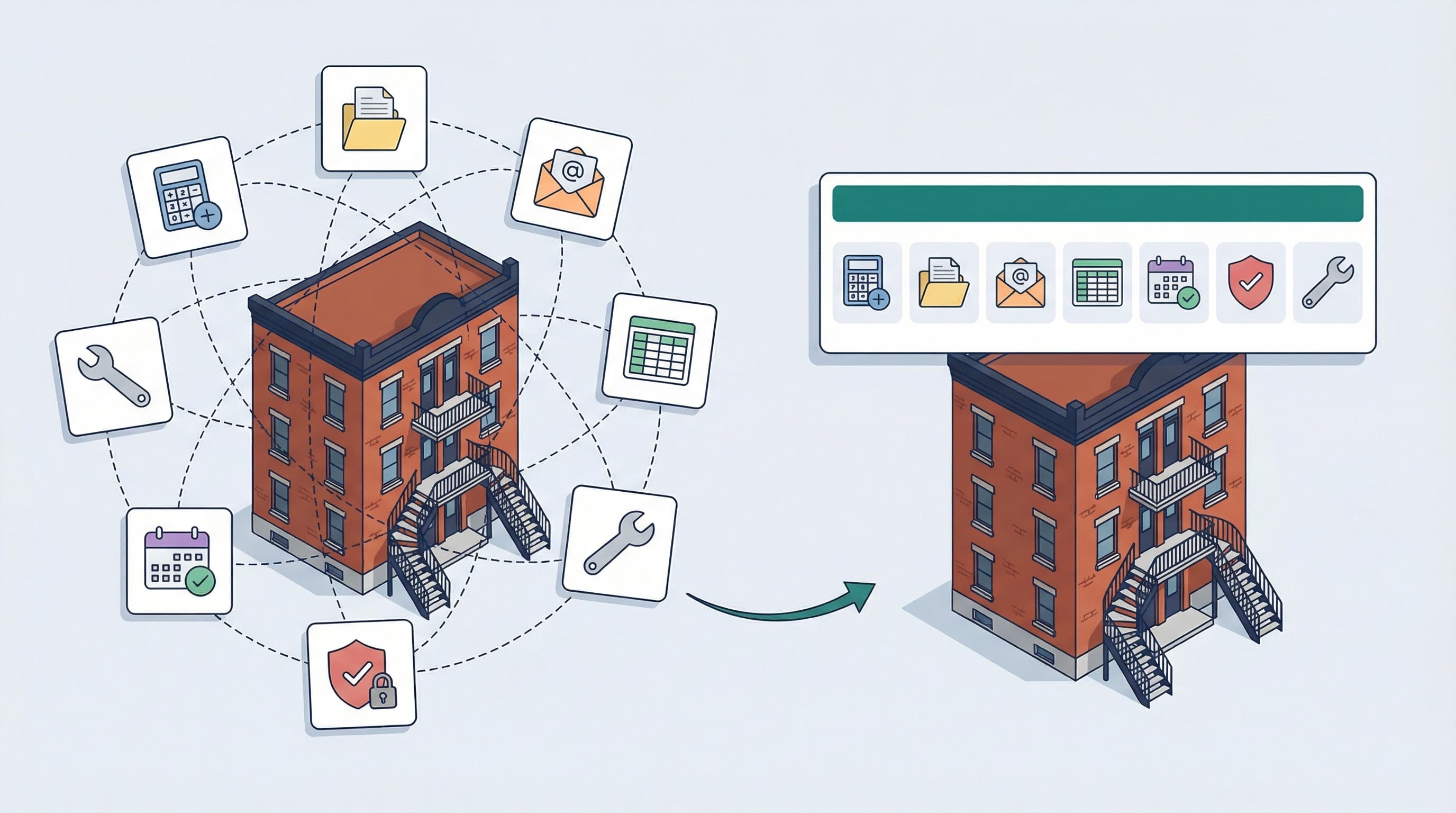
The accounting software does none of that. So you add tools. A shared folder for documents. Email for communications. A spreadsheet for the maintenance log. Maybe another tool for the co-owner portal. Each tool solves a problem and creates another: fragmentation.
The three funds — the breaking point
In Quebec condos, each association has three funds: operating, reserve (prévoyance), and self-insurance. It's a legal requirement. Every expense, every income must be attributed to the right fund. The annual budget is broken down by fund. Financial statements are produced by fund.
A general accounting app doesn't think in terms of funds. It thinks in accounts, categories, cost centers. You can simulate the three funds with classes or departments, but it's a workaround. Every inter-fund transfer becomes a manual journal entry. Budget vs. actual by fund requires a custom report you have to build yourself.
When you have one association, it's manageable. When you have three, you're maintaining three parallel hacked-together accounting structures. That's when mistakes start.
One subscription per association, no overview
General accounting tools charge per entity. Three associations, three subscriptions, three logins. You log into the first association to record expenses. Log out. Log into the second. You never see all three at once.
There's no consolidated dashboard. No "all my associations" view. No quick way to answer the question: are all my associations up to date financially?
For an accountant managing SMBs, this model works — each business is independent. But a property manager runs a portfolio. The associations are different, but the process is the same for each one. Having to redo everything three times makes no sense.
What's missing (and what you end up duct-taping together)
Here's the list of things a property manager does regularly that accounting software doesn't cover.
The condo register — the declaration of co-ownership, bylaws, minutes, resolutions. It ends up in a shared folder, organized by association, with file names that vary from one building to the next.
Assemblies — the agenda, documents to attach, budget approval, the minutes after the meeting. This happens by email, with attachments, lost replies, and overlapping versions.
The maintenance log — since Bill 16, each association must maintain a component inventory and a maintenance plan. Most managers do this in a dedicated spreadsheet. Or don't do it at all.
Insurance certificates — every co-owner must provide proof of insurance. Tracking who submitted, who's late, sending reminders — it's done manually, association by association.
Communications — notices to co-owners, request management, document sharing. Email works, but there's no centralized history, no portal, no traceability.
Every item on this list ends up in a different tool. And every different tool is an additional source of error.
The alternative: a tool built for condo management
Managers who transition to software built for condo management don't switch accounting tools — they eliminate the need for a separate one.
A condo-native tool understands the three funds. Inter-fund transfers are one action, not a journal entry. Budget vs. actual by fund is automatic. The year-end export for the accountant is formatted for condo associations, not SMBs.
And everything else — register, assemblies, maintenance log, insurance, communications, co-owner portal — is in the same system. A syndicate switcher to move between buildings. One login. One invoice.
It's not about missing features. It's about tools built for the wrong context. A general accounting app is made for businesses. A condo association isn't a business — it's a non-profit entity with legal obligations specific to Quebec.
The right time to switch
If you manage a single association and your accounting software does the job, there's probably no urgency. It's when you add a second or third association that the pain shows up. The duplication, the fragmentation, the misfiled documents — it all amplifies with each building added.
The clearest signal: when you spend more time organizing your tools than serving your clients.
CondoAide replaces your accounting software and spreadsheets with a single platform built for Quebec condo management. See the Gestionnaire plan →