A building manager is usually paid one of two ways: an amount per unit each month, or a flat monthly fee. Either one may come with GST and QST, or not.
In CondoAide, the manager is a vendor, and their fee comes from their contract. Once the contract is entered, CondoAide computes the annual cost, offers it on the « Management Fees » line of the draft budget and can plan the monthly payments in Finances.
The examples below come from a 21-unit demonstration building whose manager bills $45.00 per unit per month, plus taxes.
1. Add the manager as a vendor
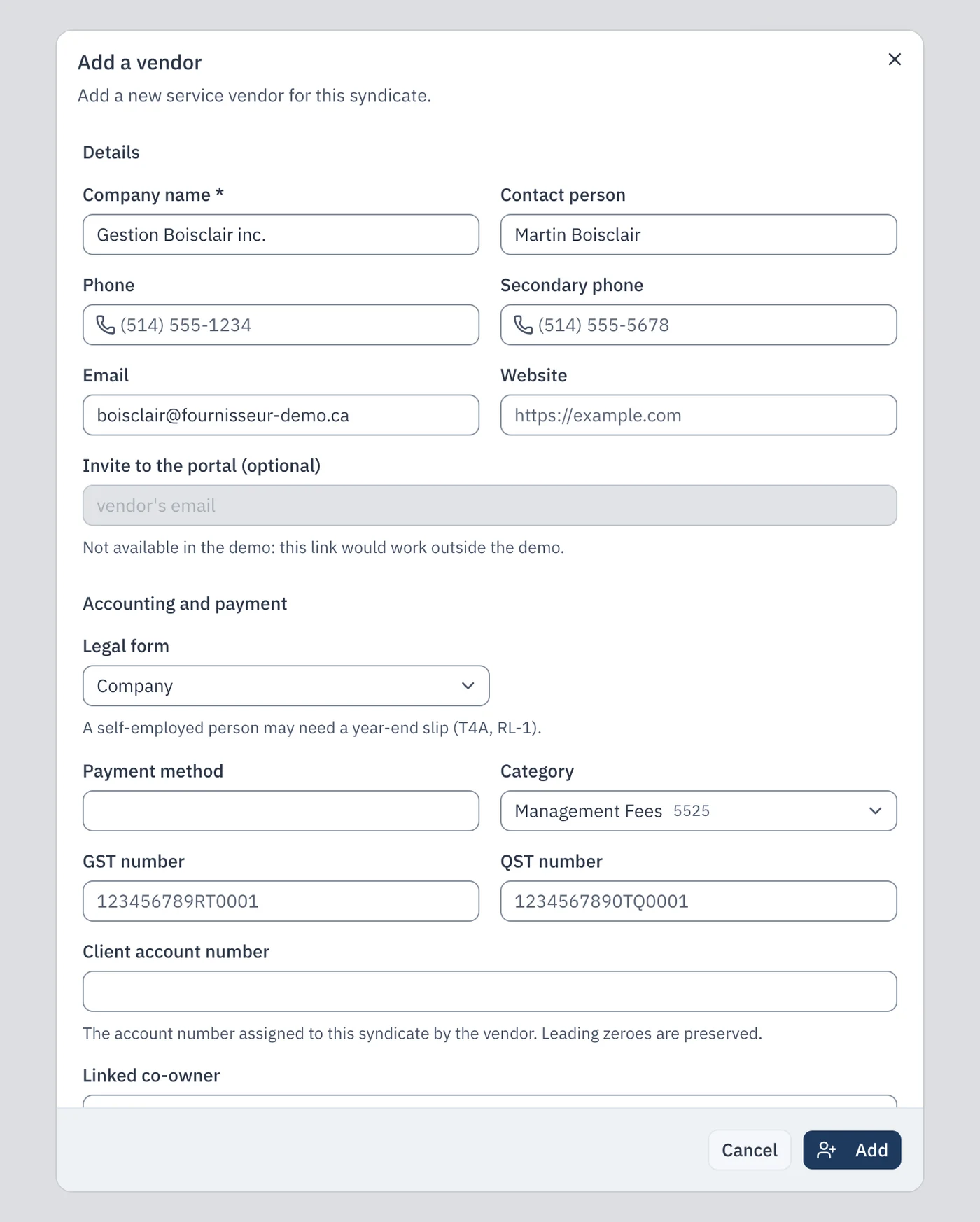
Open Vendors and click Add. Enter the company name, the contact person and their email.
Under Accounting and payment:
- Legal form: « Company », or « Individual (self-employed) » if the manager is a person working on their own account.
- Category: « Management Fees » (5525). That is the account their invoices are filed to, and the contract takes it over.
- GST number and QST number: the ones on their invoices, if they have any.
Further down, under Specialties, choose « Property management », then click Add.
2. Enter their contract
In Vendors, open the Contracts tab and click Add contract.
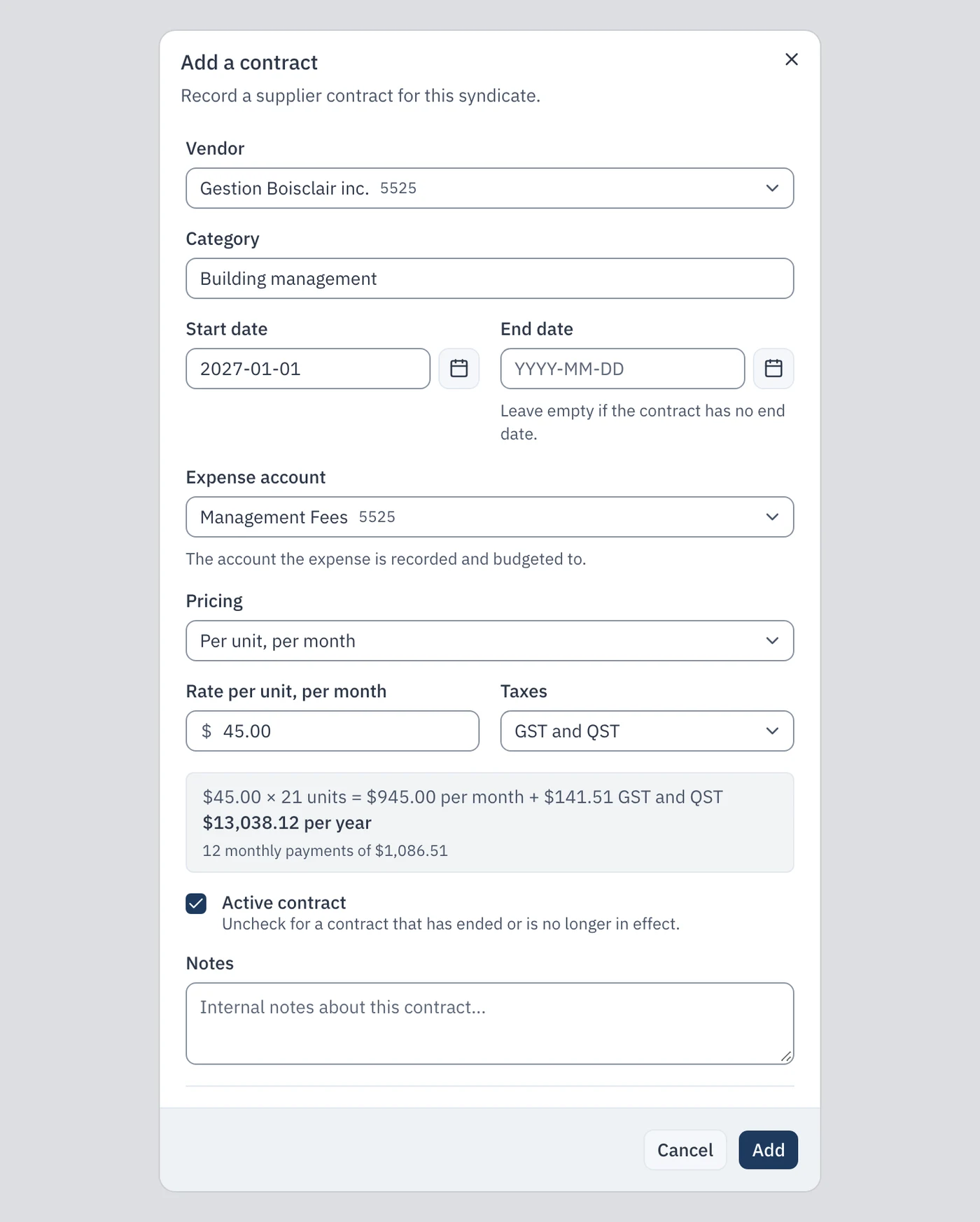
- Vendor: choose the manager. The Expense account fills in with their category, 5525 Management Fees.
- Category: a word that describes the contract, for example « Building management ».
- Start date: the first day of the contract. Leave the End date empty if the contract has no end date.
- Pricing: « Per unit, per month » if the manager bills so much per unit, « Flat monthly fee » if they bill a fixed amount each month.
- Rate per unit, per month (or Monthly amount): the amount before taxes.
- Taxes: « GST and QST » if their invoices add them, « No tax » otherwise.
Below the fields, CondoAide shows the calculation: the rate times the number of units, the taxes, the annual cost and the monthly payment. The number of units is the number of billed units: parking spaces and lockers sold separately do not count.
Click Add.
The contract shows in the list with its annual cost and its rate.

3. Read the budget line
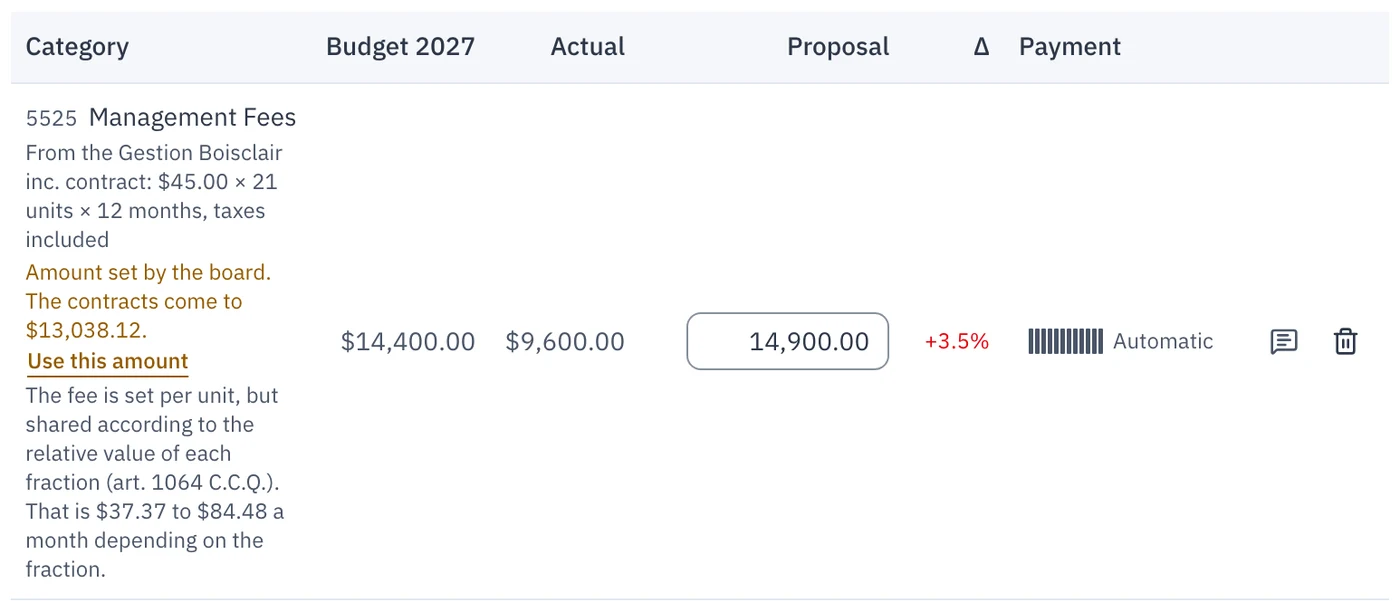
Open Budget, on the tab of the draft for the coming year. Line 5525 Management Fees says where the amount comes from: « From the … contract: $45.00 × 21 units × 12 months, taxes included ».
If the board had already entered another amount, the line keeps it and shows you both: « Amount set by the board. The contracts come to $13,038.12. » Click Use this amount to take the contract's amount.
If your chart of accounts had another line for the manager, created by hand, move its amount to line 5525 and remove the old one: line 5525 is the one the contract feeds.
4. Plan the monthly payments
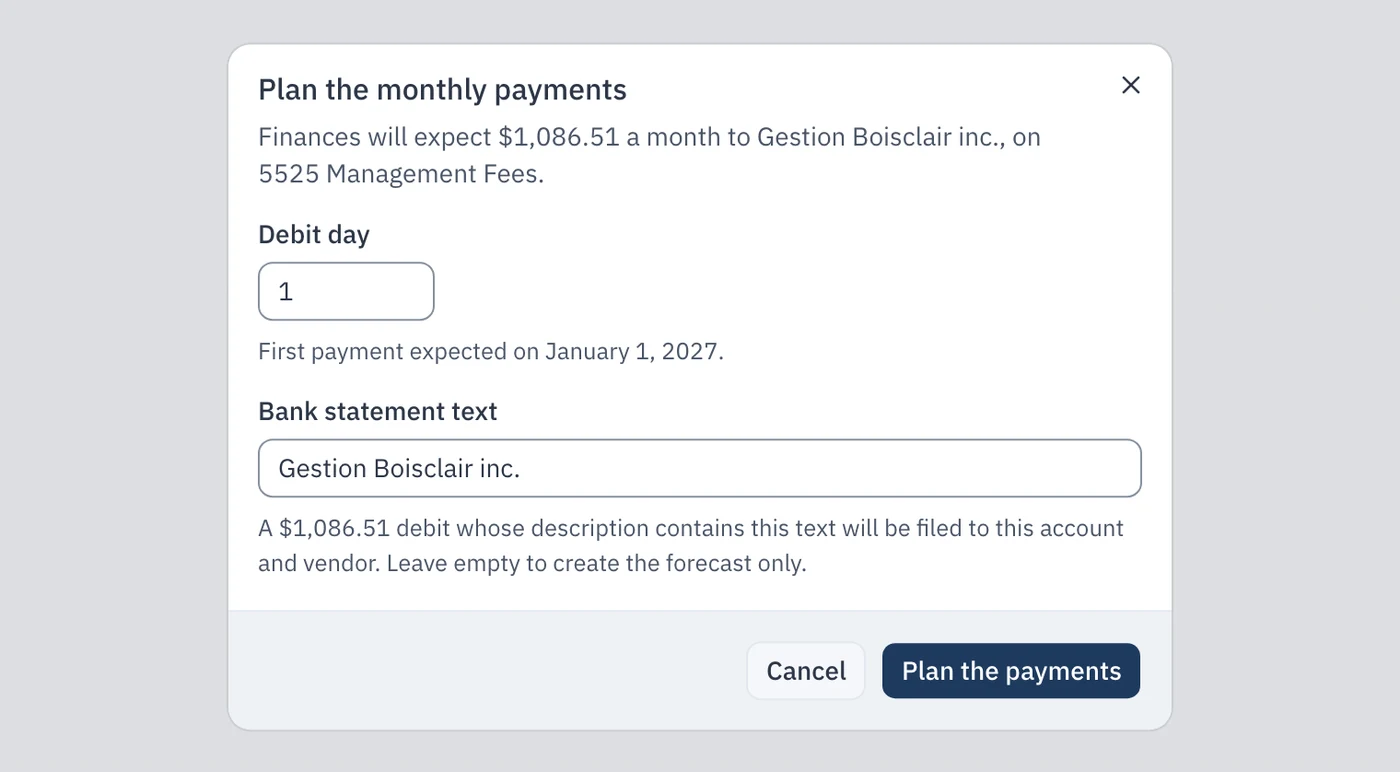
In the contracts list, click Plan the payments.
- Debit day: the day of the month the manager is paid.
- Bank statement text: a word that appears on the statement line when the payment goes out, often the manager's name. A debit of this amount whose description contains this text will be filed to account 5525 and to the manager. Leave it empty to create only the forecast.
Click Plan the payments. Finances then expects the payment each month, and the contract shows « Monthly payments planned ».
5. Why each unit does not pay the same amount
The manager bills $45.00 per unit, but no co-owner pays exactly $45.00 a month toward the fee.
The per-unit rate only serves to compute the total. That total is a common expense, and each co-owner contributes to common expenses in proportion to the relative value of their fraction (art. 1064 C.C.Q.). The board sets the budget amount, not how it is shared: the sharing follows the relative value of the fractions, set in the declaration of co-ownership.
The budget line shows what that means: in the example, from $37.37 to $84.48 a month depending on the fraction. The closer the building's fractions are to each other, the smaller that spread.
A restricted common portion expense is not a way to get an equal amount per unit. Those who use a restricted common portion, such as a balcony or a parking space, pay alone for its upkeep and routine repairs (art. 1064 C.C.Q.). The manager's fee pays for the administration of the whole building: it stays a common expense, shared among all the co-owners.